Last updated 2026-08-17
TL;DR
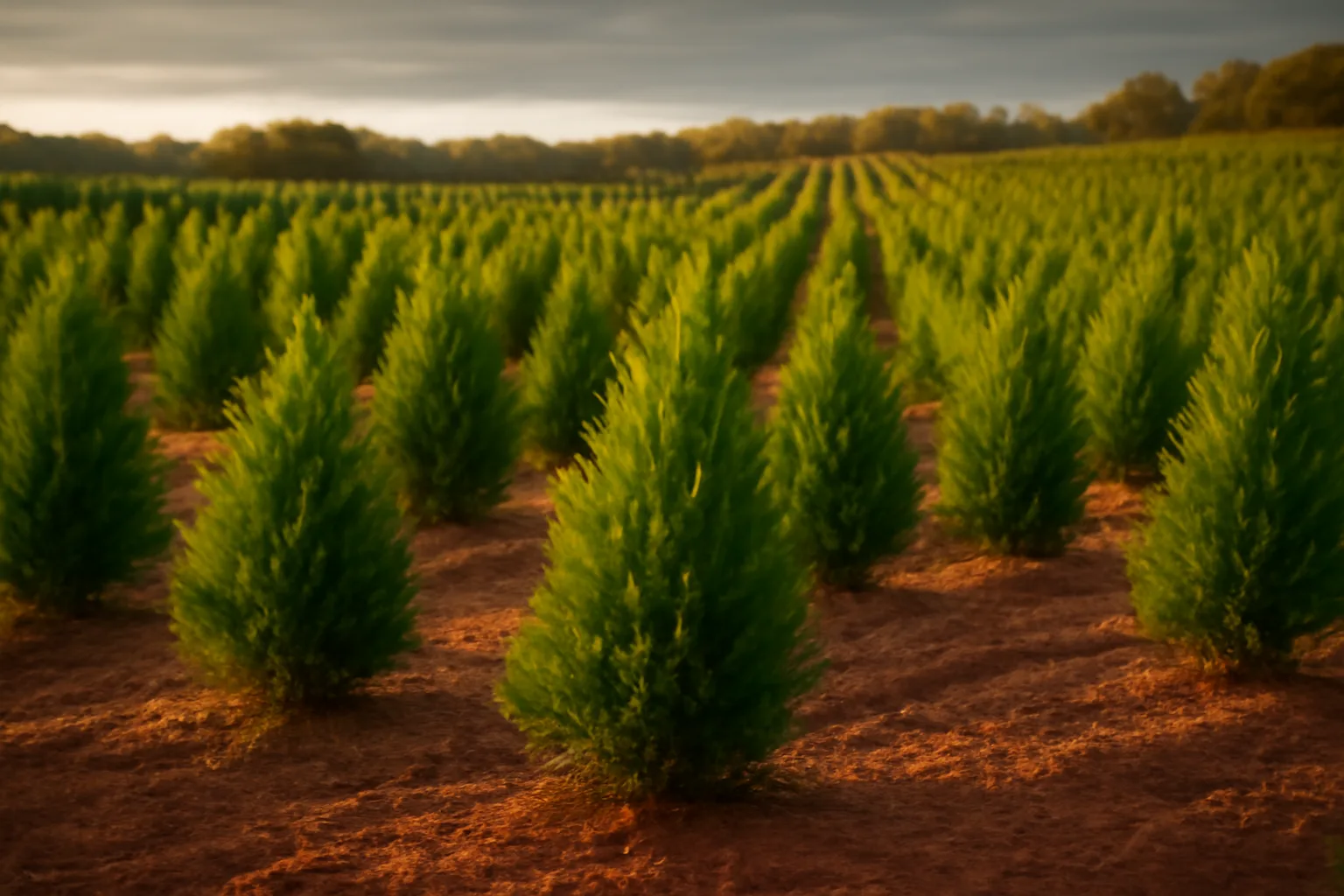
Starting a Christmas tree farm in Alabama costs roughly $3,000 to $15,000 per acre in the first year, depending on land prep, seedling species, and irrigation. Alabama does not require a state nursery dealer license just to grow and sell trees you propagate yourself, but selling plants bought elsewhere triggers nursery licensing. Trees take 6 to 10 years to reach harvest size.
How much does a Christmas tree farm cost in Alabama?
First-year cost lands between $3,000 and $15,000 per acre in Alabama. The spread is huge because it depends on three things: whether you already own the land, what species you plant, and how much fencing and irrigation you build before your first sale. The University of Georgia Cooperative Extension, which covers production economics for the Southeast including Alabama, puts bare establishment costs for Christmas trees in the $2,500 to $4,500 per acre range just for seedlings, ground prep, and planting labor [1]. Add irrigation, deer fencing, and basic equipment and a small farm getting set up properly clears $10,000 to $15,000 per acre in year one.
Here is where the money actually goes in that first year:
| Cost item | Typical range per acre | Notes |
|---|---|---|
| Land preparation (disking, herbicide, ripping) | $200, $600 | Less if you already have cleared pasture |
| Seedlings (1,500 to 1,800 trees/acre) | $800, $2,500 | Leyland cypress is cheaper; Fraser fir runs higher |
| Planting labor | $150, $400 | Hand planting on sloped land costs more |
| Deer/rodent fencing | $1,500, $4,000 | One-time capital cost, spread over seasons |
| Irrigation system | $800, $3,000 | Drip is more efficient in Alabama's dry summer stretches |
| Shearing tools and initial equipment | $300, $1,200 | Hand shears, pole saws, a small ATV if you don't own one |
| State nursery license (if applicable) | $50, $100 | Confirm current fee with ADAI |
| Contingency/replanting (10 to 15% seedling loss typical) | $100, $400 | Budget for it; you will need it |
Recurring costs from year two onward are lower. Shearing labor, fertilizer, and pest management run $300 to $700 per acre per year in the Southeast [1]. You sell nothing for six to ten years, so those costs stack up before a single dollar comes back.
For how Alabama compares to neighboring states, see the christmas tree farm cost in georgia and christmas tree farm cost in arkansas breakdowns.
Do you need a license to run a Christmas tree farm in Alabama?
There is no standalone "Christmas tree farm license" in Alabama. What exists is a nursery regulatory system run by the Alabama Department of Agriculture and Industries (ADAI) under the Alabama Nursery Act, Code of Alabama Section 2-25-1 through 2-25-14 [2]. Whether you need a nursery certificate depends on how you sell.
The law defines a nursery dealer as any person who sells, offers for sale, or distributes nursery stock. Christmas trees are nursery stock under Alabama law. So the question becomes narrow: does your operation trip the dealer definition?
Grow trees from seed or transplant on your own land and sell them direct to the customer (choose-and-cut), and ADAI has historically treated small grower-sellers differently than retail resellers. The statute itself draws no bright-line exemption for small farms. The practical move is to call ADAI's Plant Protection and Weed Management division, describe your exact setup, and confirm whether you need a Nursery Dealer Certificate along with the current fee schedule [2]. The fee sits in the $50 to $100 annual range under the statutory schedule, but confirm with ADAI because rates get updated by rule.
Beyond the nursery question, here are the licenses and registrations a new Alabama Christmas tree farm actually needs:
Business registration. Operate under any name other than your own legal name and you file a trade name (DBA) with the Alabama Secretary of State. Filing fee is around $30 to $40 [3].
Sales tax license. Alabama taxes retail sales of tangible personal property, and that includes Christmas trees. You register with the Alabama Department of Revenue for a sales tax account. Registration is free, but you must collect and remit the 4% state rate plus any county and municipal rates, which vary widely [4].
County business license. Most Alabama counties and municipalities require a business license for retail operations. Fees run from $25 to a few hundred dollars depending on projected gross receipts. Check with your county probate office or municipal clerk.
Pesticide applicator license. Apply restricted-use pesticides yourself (some herbicides and insecticides used in Christmas tree production are restricted-use) and you need an Alabama Certified Pesticide Applicator license from ADAI [5]. Hire a licensed applicator and you skip this one personally.
That's the honest list. Nobody needs a single magic permit. You need the combination above that matches your specific operation.
How long does it take to grow Christmas trees in Alabama?
Six to ten years from seedling to sale, depending on species and how hard you push growth. That is the single most important planning number in this business. You fund several years of inputs before you collect a dime.
Alabama's climate suits certain species and punishes others. The state sits in USDA Plant Hardiness Zones 7a through 8b [6], which drives the whole species decision.
| Species | Years to 6 to 7 ft in Alabama | Notes |
|---|---|---|
| Leyland Cypress | 6 to 7 years | Fastest in Alabama; handles heat and humidity well |
| Virginia Pine | 7 to 9 years | Native; low input cost; less premium price at retail |
| Arizona Cypress | 6 to 8 years | Drought tolerant; good in central/south Alabama |
| Carolina Sapphire (Arizona Cypress variety) | 6 to 8 years | Blue-silver color commands price premium |
| Fraser Fir | 8 to 10 years | Needs elevation and cooler temps; risky below Zone 6; not recommended for most of Alabama |
| Canaan Fir | 7 to 9 years | Slightly more heat tolerant than Fraser; still a gamble in south Alabama |
Most experienced Alabama growers lean toward Leyland cypress and Arizona cypress varieties for one plain reason: they survive Alabama summers without special care. Auburn University's extension service notes that conifers in the Southeast face disease pressure from root rots, Phytophthora in particular, that can wipe out sections of a planting when drainage is poor [7]. Site selection matters more than almost any other choice you make.
The time math for your plan: plant in year zero, do cultural work (shearing, herbicide, fertilizer) in years one through five or six, harvest a portion of trees in years six through eight, hit full production in years eight to ten. On a 10-acre farm, you stagger plantings across several years so trees come into harvest every season instead of everything landing at once. That staggered model also lets you learn from early mistakes before your entire investment is on the line.
What does land cost for a Christmas tree farm in Alabama?
Alabama farm real estate averaged about $3,730 per acre in 2023 according to USDA NASS land value data [8]. Cropland and pasture in the state run lower than that all-land average. Prices swing hard by region: timberland in the Black Belt runs cheaper, and land near the Birmingham or Huntsville corridors runs higher because you need customers to actually drive to you.
For a choose-and-cut operation, location is not optional. You need to sit within a reasonable drive (30 to 60 minutes is the common rule of thumb) of a population center big enough to support weekend traffic in late November and December. That usually means land near Huntsville, Birmingham, Montgomery, or Tuscaloosa is worth more for your purposes even though it costs more per acre.
Leasing instead of buying, open cropland in Alabama rents in the rough range of $50 to $150 per acre per year depending on quality and region [8]. A lease cuts your upfront capital need but complicates long-term planning, because you can't let an asset you don't own compound over a decade-long growing cycle without a solid long-term lease agreement.
Minimum viable size for a choose-and-cut farm that generates real revenue is generally 5 to 10 acres. At 1,500 trees per acre and a 10% annual harvest rate, a 10-acre farm produces roughly 1,500 trees per season at peak. At $40 to $80 per tree (a typical regional retail range), that's $60,000 to $120,000 in gross revenue at full production, before costs. Getting to full production takes a decade.
What are the startup costs for the first three years?
Year one is the most expensive by a wide margin, because you build everything from scratch. Years two and three are maintenance, not construction. Here's a realistic three-year cost picture for a 5-acre entry-level operation:
Year 1 (establishment)
- Land prep and planting: $5,000, $12,000
- Fencing (deer is the biggest threat to seedlings): $3,000, $8,000
- Basic equipment (tractor access, hand tools, ATV or UTV): $2,000, $15,000 (wide range depending on what you own)
- Irrigation setup: $2,000, $6,000
- Licensing and registration: $100, $300
- Total year 1 estimate: $12,000, $41,000
Years 2 and 3 (cultural management)
- Fertilizer, herbicide, pesticide per year: $500, $1,500
- Shearing labor or equipment: $500, $1,000
- Replanting gaps (5 to 15% loss is normal): $500, $1,500
- Total years 2 to 3 each: $1,500, $4,000
Five years of stacked cost before a single tree sells: roughly $18,000 to $50,000 for a 5-acre operation. The wide range reflects whether you own land and equipment going in. Someone starting from bare pasture they already own, with a tractor in the shed, is in a fundamentally different cost position than someone buying land and equipment from scratch.
The ChooseAndCutPath Shear-Year + Choose-and-Cut Kit ($149 one-time) covers the permit checklist, first-season operations paperwork, and planning templates if you want a structured way to map this out without hiring a consultant for the basics.
What are the ongoing annual costs once your farm is established?
Once trees are in the ground and growing, your yearly operating cost settles into a predictable pattern. The main line items break down like this.
Fertilization runs $40 to $80 per acre per year for a basic nitrogen-phosphorus-potassium program suited to Christmas trees in Alabama soils. Soil testing through the Auburn University Soil Testing Laboratory costs about $7 to $10 per sample and tells you exactly what your field needs instead of guessing [7].
Herbicide and weed control is often the biggest variable. Hand weeding is slow and expensive. Chemical weed control needs the applicator license mentioned earlier but is far cheaper at scale. Budget $50 to $150 per acre per year.
Shearing is the most time-consuming annual task. Done by hand, figure 2 to 4 minutes per tree, which on a 5-acre farm means a few hundred hours of labor spread over summer. Hire help or do it yourself. Either way, budget $200 to $600 per acre per year depending on labor cost.
Pest and disease management varies year to year. Bagworms, tip moths, and root diseases are the main threats in Alabama. Some years you spend nothing. A bad bagworm outbreak on unprotected trees can mean $100 to $300 per acre in treatment.
Marketing and harvest-season expenses (signage, advertising, portable toilets, a payment system, liability insurance) add another $1,000 to $4,000 per season for a small choose-and-cut operation.
Farm liability coverage is the last piece. For a small choose-and-cut operation, general liability runs roughly $500 to $1,500 per year depending on acreage, visitor volume, and carrier. This is not optional once you invite the public onto your land.
What does Alabama's nursery licensing actually require?
The Alabama Nursery Act (Code of Alabama Section 2-25-1 through 2-25-14) governs the sale of nursery stock in the state [2]. A Nursery Dealer Certificate comes from ADAI's Plant Protection and Weed Management section, and the statute requires it of any "nursery dealer" who sells or offers nursery stock for sale.
For growers who raise their own stock on their own property and sell direct to the public, ADAI has discretion in how they apply this, but the statute does not explicitly exempt you. The practical step is to call ADAI's nursery program at (334) 240-7239, describe your exact operation, and get the answer in writing if you can.
Buy young trees (liners) from a wholesale nursery and resell them, or bring in pre-cut trees from out of state to sell on a lot, and the dealer certificate requirement applies clearly.
Growers who also hold a spring plant sale, or sell wreaths and garland made from nursery material, face a broader licensing question. Each product type can carry its own regulatory treatment.
The inspection side matters too. ADAI inspectors may visit nurseries to check for pests and diseases. Keeping good records of where your seedlings came from (a certificate of origin or equivalent from the supplier) helps with any inspection visit [2].
Are there any Alabama grants or cost-share programs for Christmas tree farmers?
Yes, and most new growers ignore them to their own financial cost. The USDA Natural Resources Conservation Service (NRCS) runs the Environmental Quality Incentives Program (EQIP) in Alabama [9]. EQIP can cost-share practices like irrigation system improvements and tree or shrub planting that overlap with Christmas tree production. Payment rates and eligible practices change each funding year, so check with your local NRCS field office (Alabama has offices in most counties) to see what's currently funded.
The USDA Farm Service Agency (FSA) is your access point for farm loans, including Operating Loans and Farm Ownership Loans that can finance startup costs at lower interest rates than commercial lenders [10]. FSA also runs some disaster programs, though those matter less for tree growers.
The Alabama Forestry Commission does not typically run cost-share specific to Christmas trees, but its foresters can provide technical help and sometimes access to seedling programs.
Alabama A&M and Auburn both run extension services. Auburn's Alabama Cooperative Extension System publishes production guides for specialty crops and can sometimes connect growers with small-farm grants through USDA Sustainable Agriculture Research and Education (SARE) [7].
What species actually work in Alabama's climate?
Leyland cypress and Arizona cypress are the species that actually work across most of Alabama. A lot of first-time growers make expensive mistakes by planting what they grew up seeing up north. Fraser fir is the gold standard nationally, but it needs cool summers and does best above 3,000 feet in Appalachian growing zones. Most of Alabama is not that.
Leyland cypress is the workhorse of Alabama Christmas tree production. It grows fast, takes the heat, and customers expect it. The main knock is a disease called Seiridium canker, which can defoliate and kill branches. Good site selection (well-drained, full sun, good air circulation) reduces but doesn't erase the risk [7].
Arizona cypress and its varieties, including Blue Ice and Carolina Sapphire, are getting more attention in Alabama because they handle drought and heat better than Leyland and carry a blue-silver color that commands a price premium at retail. They're a reasonable bet in central and south Alabama.
Virginia pine is native and cheap to establish, but its scrubby natural form needs heavy shearing to look like a Christmas tree. Growers who put in the shearing work can produce a decent tree, but it takes more labor per tree than cypress.
For north Alabama, especially the northeastern corner where elevation and cooler temperatures prevail, Canaan fir and white fir become more viable. Even so, call your local Auburn Extension agent and ask what's actually working in your county before you order 10,000 seedlings. Nobody has perfect data on Alabama-specific variety performance, but the extension network has practical observations from real Alabama growers.
How do choose-and-cut farms price trees and generate revenue in Alabama?
Choose-and-cut trees in the Southeast retail in the $35 to $90 range for a typical 6 to 7 foot tree, with premium species and well-shaped trees hitting the top end. Pre-cut trees sold on a lot can pass $100 for a well-shaped Fraser fir. Alabama-specific retail data is sparse, but the National Christmas Tree Association's surveys put the national farm-gate average around $78 per tree in recent years [11].
Revenue diversification separates farms that survive from ones that fold. Wreath-making with tree trimmings adds margin. Hot cider, family photos, and a small parking or entry fee are common add-ons. Container-grown ornamental trees, garland sold by the foot, and a weekend December market all add revenue without adding growing land.
The math on a 10-acre operation at full production: roughly 15,000 trees planted, expecting 10 to 15 percent annual harvest at maturity, so 1,500 to 2,250 trees per season. At $50 average retail, that's $75,000 to $112,500 gross before any add-on revenue. Operating costs at that scale run roughly $15,000 to $30,000 per season including labor, insurance, and marketing. Net margins of 30 to 50 percent are achievable on a well-run farm at full production. Getting there takes a decade of investment first.
For how neighboring states structure operations differently, the christmas tree farm cost in georgia and christmas tree farm cost in florida articles cover the regional variation.
What permits do you need before you open to the public?
Opening a choose-and-cut farm to the public in Alabama adds a layer of requirements on top of the production licenses. Start with zoning and work down.
Zoning is the first thing to check. Agricultural land in Alabama is generally allowed for direct farm sales under the state's right-to-farm protections, but if your land sits inside or near a municipal boundary, local zoning may restrict retail activity or require a special use permit. Call your county planning office before you build parking areas or put up signage.
Signage permits may apply. Temporary or permanent signs visible from state roads typically fall under Alabama Department of Transportation rules or county road ordinances.
Prepare and sell food (hot cider, baked goods) and the Alabama Department of Public Health regulates the sale. A cottage food or temporary food establishment permit may apply [12].
Restroom facilities are required once you are regularly open to the public under most county health department interpretations. A portable toilet service is the practical low-cost fix for seasonal operations.
Parking and traffic flow matter for safety and for county road access rules. If your driveway opens onto a state highway, ALDOT may require a driveway permit for commercial traffic volumes [13].
Liability insurance is not a government permit, but it's functionally required if you want a farm loan, if you lease your land, or if you have basic business sense. A general commercial liability policy for an agritourism operation in Alabama runs roughly $500 to $1,500 per year. Alabama's Agritourism Act (Code of Alabama Section 6-5-340) gives some liability protection to operators who post the required notice at the entrance, but posting a sign does not replace insurance [14].
The ChooseAndCutPath Shear-Year + Choose-and-Cut Kit includes a state-specific permit checklist that maps the exact sequence for Alabama operations, which helps if you want to make sure you haven't missed a county-level step.
Frequently asked questions
Do you need a license for a Christmas tree farm in Alabama?
There is no single "Christmas tree farm license" in Alabama. You likely need a Nursery Dealer Certificate from ADAI if you sell nursery stock, a sales tax account from the Alabama Department of Revenue, and a county business license. If you apply restricted-use pesticides yourself, an Alabama Certified Pesticide Applicator license is also required. Confirm the nursery dealer requirement with ADAI directly since it depends on your specific operation.
How much does it cost to start a Christmas tree farm in Alabama?
First-year establishment runs roughly $3,000 to $15,000 per acre depending on land prep, species, fencing, and irrigation. A 5-acre entry-level operation typically costs $12,000 to $41,000 in year one, with $1,500 to $4,000 in annual maintenance costs in years two and three before any trees are sold. The wide range reflects whether you own land and equipment going in.
How long does it take to grow Christmas trees in Alabama?
Six to ten years from seedling to harvest-ready tree, depending on species. Leyland cypress and Arizona cypress, the most common Alabama species, typically reach 6 to 7 feet in 6 to 7 years. Fraser fir takes 8 to 10 years and is generally not recommended for most of Alabama due to heat stress. Plan for at least a decade before a farm reaches full production.
What is the Alabama Nursery Dealer Certificate and does a Christmas tree farm need one?
The Alabama Nursery Dealer Certificate is issued by ADAI under the Alabama Nursery Act (Code of Alabama 2-25-1 through 2-25-14). It is required of anyone who sells nursery stock, which includes Christmas trees. Growers who grow and sell their own trees have some discretion in how ADAI applies the requirement, but the safe path is to call ADAI at (334) 240-7239 and confirm in writing.
What Christmas tree species grow best in Alabama?
Leyland cypress is the most widely grown species in Alabama because it tolerates heat and grows fast, typically reaching harvest size in 6 to 7 years. Arizona cypress varieties like Carolina Sapphire perform well in central and south Alabama. Virginia pine is native and low-cost but requires heavy shearing. Fraser fir is generally too heat-sensitive for most of the state.
Does Alabama have any grants for Christmas tree farmers?
USDA NRCS runs the Environmental Quality Incentives Program (EQIP) in Alabama, which can cost-share certain farm practices including irrigation and tree planting. USDA FSA offers Operating Loans and Farm Ownership Loans at lower-than-commercial rates. Contact your local NRCS or FSA office to check current funding availability and eligible practices for your specific operation.
Do I need to collect sales tax on Christmas tree sales in Alabama?
Yes. Christmas trees are tangible personal property subject to Alabama sales tax. You register with the Alabama Department of Revenue for a sales tax account at no fee. The state rate is 4%, plus applicable county and municipal rates, which vary. Failure to collect and remit is a liability issue, so register before your first sale.
How many acres do you need for a Christmas tree farm in Alabama?
A minimum of 5 acres is the common starting point for a financially viable choose-and-cut operation. At 1,500 trees per acre and a 10 percent annual harvest rate, 5 acres at full production yields roughly 750 trees per season. Ten acres is a more common target for operations trying to generate meaningful seasonal revenue. Smaller plots work for hobby or supplemental income setups.
What does Alabama's Agritourism Act do for Christmas tree farm liability?
Alabama's Agritourism Act (Code of Alabama Section 6-5-340) limits landowner liability for injuries to agritourism participants if the farm posts a required warning notice at the entrance. The protection applies to inherent risks of agritourism activities. It does not cover gross negligence or intentional harm, and it does not replace the need for commercial general liability insurance.
How much can a Christmas tree farm in Alabama earn?
A 10-acre farm at full production can harvest 1,500 to 2,250 trees per season. At $40 to $80 per tree retail, that's $60,000 to $180,000 in gross revenue. After operating costs of $15,000 to $30,000 per season, net margins of 30 to 50 percent are achievable on well-run operations. But full production takes 8 to 10 years of investment to reach.
Do I need a pesticide applicator license to run a Christmas tree farm in Alabama?
Only if you personally apply restricted-use pesticides. Some herbicides and insecticides used in Christmas tree production carry restricted-use classification, which requires an Alabama Certified Pesticide Applicator license from ADAI. If you hire a licensed commercial applicator to handle those products, you don't need the license yourself. General-use pesticides can be applied without a license.
What is the cost of land for a Christmas tree farm in Alabama?
Alabama farm real estate averaged about $3,730 per acre in 2023 per USDA NASS, with cropland and pasture running lower. Prices vary by region: rural timberland in the Black Belt costs less, land near Huntsville or Birmingham is higher. Open cropland leases run roughly $50 to $150 per acre per year. Location near population centers matters for choose-and-cut farms because you need customers to drive to you.
How do I stagger plantings on a Christmas tree farm in Alabama?
Plant a new section each year for 6 to 8 years so you have trees coming into harvest every season rather than everything maturing at once. On a 10-acre farm, for example, plant roughly 1.5 acres per year. This smooths cash flow, lets you learn from early mistakes, and avoids having your entire investment exposed to a single bad growing season.
What opening-to-the-public permits does an Alabama Christmas tree farm need?
Check local zoning first. You may need county signage permits, ALDOT driveway access approval if you're on a state highway, and an ADPH food establishment permit if you sell prepared food. Alabama's Agritourism Act requires a posted warning sign at entry. Restroom facilities are effectively required for regular public operations. Commercial general liability insurance is not a permit but is practically essential.
Sources
- University of Georgia Cooperative Extension Publications: First-year establishment costs for Christmas trees in the Southeast range $2,500 to $4,500 per acre for seedlings, ground prep, and planting; recurring annual cultural costs run $300 to $700 per acre
- Alabama Legislature, Code of Alabama Section 2-25-1 through 2-25-14, Alabama Nursery Act: Alabama Nursery Dealer Certificate is required of any person who sells or offers nursery stock for sale, including Christmas trees
- Alabama Department of Revenue, Sales and Use Tax: Alabama imposes 4% state sales tax on retail sales of tangible personal property including Christmas trees; registration for sales tax account is required before first sale
- Alabama Department of Agriculture and Industries: Alabama Certified Pesticide Applicator license required from ADAI to personally apply restricted-use pesticides
- USDA Agricultural Research Service, USDA Plant Hardiness Zone Map: Alabama falls within USDA Plant Hardiness Zones 7a through 8b
- Auburn University Alabama Cooperative Extension System: Conifers in the Southeast face disease pressure from Phytophthora root rots; Leyland cypress susceptible to Seiridium canker; Auburn Soil Testing Lab costs $7 to $10 per sample
- Alabama Department of Public Health, Food and Lodging: Alabama Department of Public Health requires food establishment permits for on-farm food sales including prepared beverages
- Alabama Department of Transportation, Permits: Commercial access onto state highways may require an ALDOT driveway permit when traffic volumes increase
- Alabama Legislature, Code of Alabama Section 6-5-340, Agritourism Liability: Alabama Agritourism Act limits landowner liability for injuries to agritourism participants if a required warning notice is posted at the entrance; does not cover gross negligence