Last updated 2026-08-21
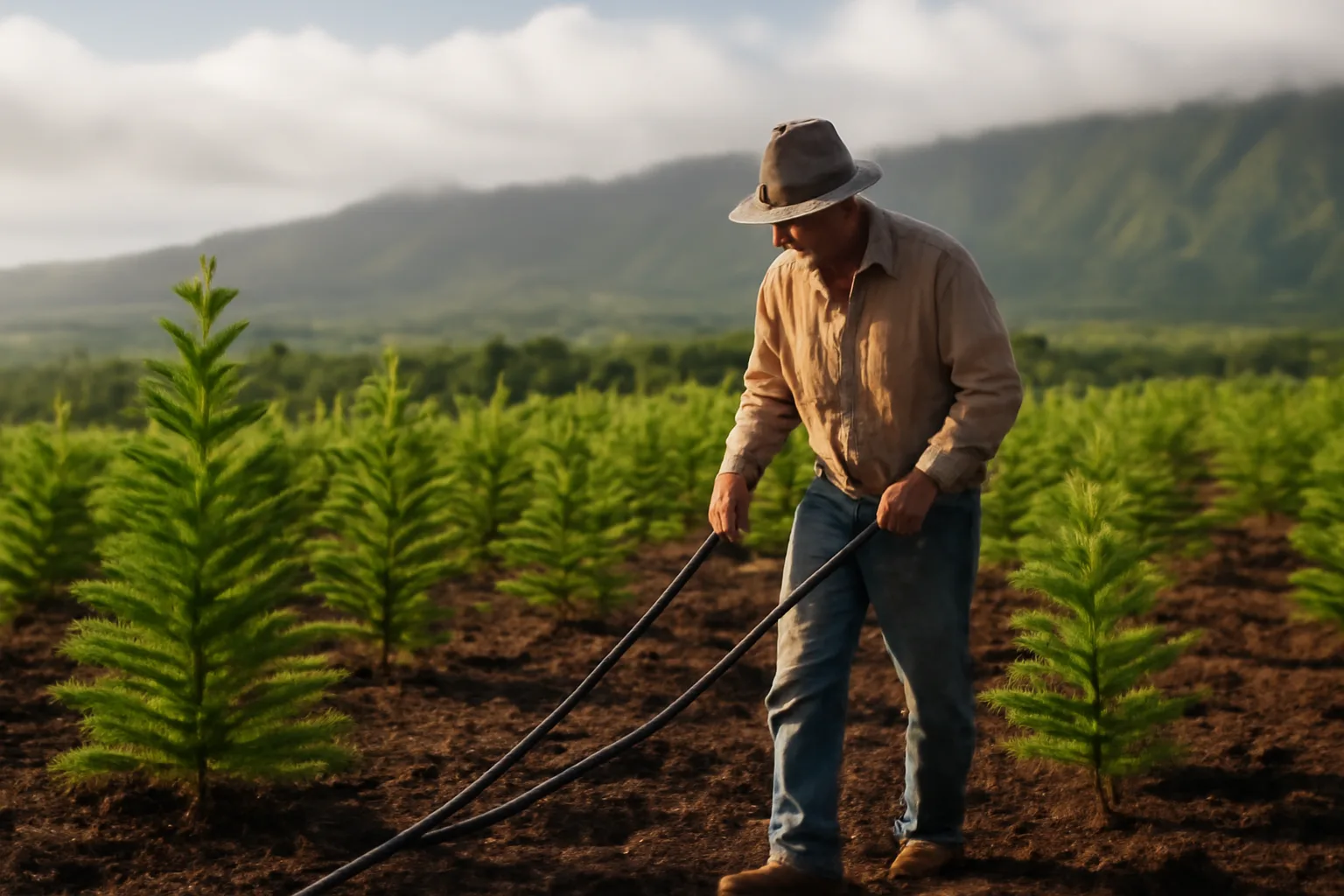
TL;DR
Hawaii does not issue a Christmas tree farm license. Selling trees is a business, so you need a general excise tax license and a DCCA entity registration, then you keep those alive with tax filings and annual reports. Land must stay in a use state and county law allow. Trees take several years. Confirm every fee with the board that issues it. Nobody can honestly quote one statewide startup cost.
Do you need a license for a Christmas tree farm in Hawaii?
There is no Hawaii license titled Christmas tree farm. If you sell trees, wreaths, potted pines, or choose-and-cut admission, you are in business. You need a general excise tax license from the Department of Taxation and you need the business registered with the Department of Commerce and Consumer Affairs. County zoning has to allow the agricultural use. Confirm current forms with each board.
HRS §237-9 is the statute that actually matters. It says a person with gross income subject to the privilege tax "shall in writing apply for and obtain from the department of taxation, upon a one-time payment of the sum of $20, a license" before engaging in or continuing the business. [1] HRS §237-9 sets the GET license payment at a one-time sum of $20. You still pull the live Form BB-1 instructions from DOTAX, because the online path changes even when the statute dollar figure does not. [2]
I would not wait until the first Saturday in December. The GET license is what makes the cash register legal. Selling without it is how people collect assessments, penalties, and a very bad January. The license is not an annual farm permit. You keep it alive by filing returns on the frequency DOTAX assigns.
DCCA is the other half. A sole proprietor can sometimes hold GET under a trade name. If the public will walk your rows, I'd form an LLC anyway. Then you file the annual report the limited liability company statute requires. [4] Confirm the live filing on Hawaii Business Express. A Facebook page is not a license.
If you only grow trees for your own living room, you do not need any of this. The moment money changes hands, the tax license is the gate.
What actually renews each year on a Hawaii Christmas tree farm?
The GET license itself is one-time under HRS §237-9. What comes back is the tax-return cycle, the DCCA annual report for entities, insurance, and any county or lease paper with an end date. [1] [4] That stack is the real "renewal."
DOTAX assigns monthly, quarterly, or less frequent GET filing based on tax liability. Confirm your assigned frequency inside HITAX. Missing returns is how a cheap one-time license turns into collections. Keep Saturday gross-proceeds notes. You will need them.
Entities file every year. HRS §428-211 requires a limited liability company to deliver an annual report to DCCA. [4] If that lapses, the company can be terminated. Reinstatement wastes a season. Put the due date on a calendar the day you form.
Pesticide applicator certification is not an annual farm card for everyone. It is a recertification cycle run by the HDOA Pesticides Branch. Confirm the current period and credit hours with that branch. [8] Hand shearing does not need that card. Restricted-use spray does.
Agricultural dedication at the county is a multi-year deal, then you renew or you lose the use valuation. Honolulu publishes the dedication rules on its real property site. [14] State ag-park and other government leases have their own windows. If you do not own the land, the lease is the farm.
| Paper | Repeats? | Board |
|---|---|---|
| GET license | One-time $20 in HRS 237-9, then returns | DOTAX |
| GET returns | Monthly or other assigned cycle | DOTAX |
| LLC annual report | Yearly | DCCA |
| Ag dedication | Multi-year term, then file again | County finance |
| Pesticide certificate | Recertification cycle | HDOA |
| Land lease | Per the contract | Landowner or state |
Buy the liability policy before the first public Saturday. Not after someone trips on a'a.
How much does a Christmas tree farm cost in Hawaii?
Nobody publishes a clean, current, statewide cost to open a Christmas tree farm in Hawaii. Anyone handing you one number is guessing. Land dominates. Irrigation is next. Feral pig fencing is not optional on most islands. Labor costs more here than on a mainland plantation because wage law and the Prepaid Health Care Act sit on ordinary payroll. [9] [11]
GET and DCCA fees are small next to land. The GET license payment in statute is $20. [1] Formation and annual reports cost more than that. They are still rounding error compared with a well, a tank, and a hog-tight fence.
I would budget water before I budget a cute retail shed. Leeward plantings die without irrigation. Windward plantings still need a drought plan. Drip plus storage is the grown-up version. A mainland "rainfall will handle it" sheet is a waste of money here.
Pigs are where copied Oregon plans fail. A new planting without a serious fence is hog feed. I'd rather delay the first acre than plant an unfenced acre. NRCS sometimes cost-shares fence and irrigation through EQIP. Ask the Hawaii NRCS office. That is a conversation, not a promise.
Retail extras (gravel, toilets, a tent) only matter if the public comes on the land. A wholesale-only block can skip most of that. Choose-and-cut in Hawaii is a small market. Do not build a mainland-style festival in year one.
Confirm land prices with county assessments and a local ag broker. An Oahu ag parcel and a Ka'u pasture are not the same market. I will not invent a per-acre figure.
How long does a Christmas tree farm take in Hawaii?
A Hawaii Christmas tree farm does not produce a 6-foot retail tree in one season. True firs that mainland farms run on a 7 to 10 year cycle generally do not perform in lowland Hawaii heat. Growers here usually plant Cook pine or Norfolk Island pine. The USDA PLANTS database treats Cook pine (Araucaria columnaris) as its own taxon, not as a Fraser fir you can order from Oregon and forget. [13]
I have not found a peer-reviewed, Hawaii-wide rotation table I trust enough to treat as a clock. CTAHR forestry staff and other island growers are the honest source for years to a shearable height on your elevation and rainfall. Expect several years of weeding, water, and formative cuts before you advertise a field. Anyone promising a full choose-and-cut canopy next December from bare ground is selling a story.
Paper can eat months before the first seedling. GET and DCCA are relatively fast if the filing is clean. County SMA assessments, grading permits, and conservation-district review are not fast. Confirm processing with the county that has the tax map key. No board promises a fixed date, and neither will I.
If you are on a lease, read the remaining term. A 3 year remaining lease and a 6 year tree is a bad match. Renewal of the land right is the farm renewal that actually matters.
Which Hawaii tax licenses and filings keep a farm legal?
Retail Christmas tree sales are generally taxed at the 4 percent GET rate under HRS §237-13. Most counties add a surcharge on top. Wholesaling to a true retailer is a different rate, 0.5 percent, if you actually qualify as wholesale. [3] [2] Confirm how your invoices are classified with DOTAX. Misclassifying retail as wholesale is a classic audit problem.
DOTAX describes the GET as a privilege tax on business activity in the State of Hawaii. [2] You file on the frequency they assign. Keep gross proceeds for every sales day, including pre-cut and choose-and-cut.
County surcharge rates live on the department's county surcharge page and they have changed by island over the years. Confirm the rate in force for your county before you print a price list. [15] Do not copy a number from a forum post.
GET is on gross proceeds, not on profit. A year you lose money on fertilizer you still owe tax on what you collected. Price the trees with that in mind.
If you add food, crafts, or paid parking, ask DOTAX how those line up. Do not assume one farm story covers a craft fair.
What county and land-use paper can block a farm renewal?
State land-use law has to allow the crop, and county zoning has to agree. HRS §205-4.5 lists permissible uses in the agricultural district. It includes "Cultivation of crops, including crops for bioenergy, flowers, vegetables, foliage, fruits, forage, and timber." [5] Growing Christmas trees sits inside that crop and timber language. A special management area or conservation overlay can still stop a building or a parking lot.
Call county planning before you order seedlings. Ask whether the parcel is in the state agricultural district and what county zoning sits on it. Then ask whether public choose-and-cut is ordinary agriculture or a commercial visitor use that needs its own permit. Those answers differ by island.
If the land is in the SMA, even a modest structure can trigger review under HRS chapter 205A. Conservation district land goes through DLNR OCCL. I would not buy conservation land for a retail farm unless you already understand that process.
Agricultural dedication can cut real property tax if you meet the county's use and acreage rules and you stay in the program. Honolulu spells out agricultural dedication on its real property site. [14] Dedication is a contract. Break the use and you can owe rollback taxes. Read the term before you sign.
Compare this with how Christmas tree farm renewal in California treats county use permits. Hawaii's state land-use overlay is the piece mainland checklists miss.
Do you need a nursery or plant quarantine registration in Hawaii?
Hawaii controls plant movement more tightly than most states. You may not need a "nursery card" to cut trees on the same parcel where they grew, but you do need Plant Quarantine in the conversation the moment stock, pots, or interisland boxes enter the plan. Confirm the exact registration, if any, with HDOA for the stock you will sell.
HRS §150A-5 sets conditions of importation for plants and other articles. The Plant Quarantine Branch runs the live rules. [6] [7] If you import starter plants or seed, you work through that branch. Do not have a mainland nursery drop a trailer at the harbor and hope.
Interisland movement is its own problem. A clean planting on Hawaii Island is not automatically free to sail to Oahu. Confirm current inspection steps with Plant Quarantine before you book a barge. This is where farms get surprised.
Whether you also need nursery registration to sell potted trees or liners is a question for HDOA, not for a comment thread. I will not invent a fee or a form number. Call Plant Industry, describe the exact stock (bare-root, potted, cut), and write down what they say.
Pesticides are separate. Restricted-use products need applicator certification from the Pesticides Branch, then recertification on their cycle. [8] Hand tools do not.
What employer filings come back every year in Hawaii?
If you hire people, Hawaii is not a casual-labor state. Workers' compensation, temporary disability insurance, unemployment insurance, and, for many regular employees, prepaid health care all sit on the employer. [9] [10] Confirm coverage thresholds with DLIR. Do not copy a mainland "family weekend crew" plan.
The Prepaid Health Care Act is the one mainland owners miss. HRS §393-11 is the coverage statute. DLIR summarizes employer duties on its PHC page. [9] [10] If a cutter meets the hour and employment tests, health care is not optional goodwill. It is a cost line. I would model payroll with PHC and TDI included before I advertise cheap trees and six weekends of help.
Minimum wage is set in HRS §387-2 and the dollar figure steps on dates the legislature wrote. [11] Confirm the rate in force with the Wage Standards Division. Do not use last year's number from memory.
TDI is another Hawaii-specific policy. DLIR's TDI page is the practical starting point for what an employer must carry. [12] Pair it with workers' compensation. A choose-and-cut Saturday with a saw and a ladder is exactly the claim you do not want uninsured.
I'd rather stay a two-person family crew in year one than hire under-documented seasonal help. The paper is the job.
How do imported cut trees differ from a real Hawaii farm?
Most Christmas trees standing in Hawaii living rooms in December were not grown here. They were imported, then run through Plant Quarantine because frogs, slugs, and other hitchhikers are a real interdiction problem. [7] That import path is not farm renewal. It is a retailer and shipper path. Do not mix the packets.
A farm conversation is GET, DCCA, land use, water, and (if you ship plants) nursery and interisland rules. An import conversation is notices to HDOA, inspection appointments, and rejected lots. If you plan to grow some and import some, you are running two businesses that share a parking lot.
I'd pick one for the first three years. Growing is slow. Importing is seasonal cash with inspection risk. Doing both while you still do not have drip in the ground is how people burn December.
If your "farm" is actually a lot of imported cuts plus a few potted Cook pines, say that to the county and to DOTAX. Honesty on use is cheaper than a land-use complaint from a neighbor who thought they lived next to a quiet orchard.
For a sense of how different the mainland renewal pile looks, skim Christmas tree farm renewal in Colorado or christmas tree farm renewal in Arizona. Those states argue about different pests and different tax names. Hawaii's plant quarantine culture is the outlier.
What do first-year operations look like after you plant?
First year is irrigation, weed control, and records. It is not a retail weekend. Plant what you can water. Mark rows so you can find them in guinea grass six months later. Start a simple map and a shear log even if the log is mostly "hand weeded, row 4."
Get an FSA farm number if you may want NAP or other USDA programs later. That office will want acreage and operator identity. It is dull. It is useful after a hurricane or a drought.
Shearing comes after the trees have a year or two on them, depending on species and height. Do not buy a large mechanical shearer for two acres of Cook pine. Hand shears and a folding saw are enough until you hate your elbows. That is also the honest place for a paper kit. ChooseAndCutPath sells a $149 one-time Shear-Year + Choose-and-Cut Kit if you want a single checklist for first-season records. It is a publisher kit. It does not file your GET return and it is not legal advice.
Windward versus leeward changes everything. A plan copied from Hilo will cook in Waikoloa. Walk the site at 2 p.m. in August before you believe a pretty morning photo.
Compare first-year pacing with christmas tree farm renewal in Florida if you want another warm-climate checklist. Florida still is not Hawaii water law.
What paper should you pull before you spend on trees?
Pull these before you spend serious money. HITAX account and GET license status. DCCA entity status and annual report due date. A dated note from a county planner with a name on it. Tax map key, state land-use district, SMA flag. Water meter or catchment notes, in writing. If leased, remaining term and renewal clause. If you will hire, the DLIR checklist for WC, TDI, UI, and PHC. If you will move plants, a Plant Quarantine answer in writing. [2] [4] [7] [10]
I would not buy 2,000 liners on a verbal "agriculture is fine here." Counties enforce parking, access, and structures even when the trees themselves are a permitted crop.
Keep PDFs. When a clerk asks for the GET number in three years, you will not remember the email.
If you like seeing how another state stacks the same pile, christmas tree farm renewal in Alabama and christmas tree farm renewal in Alaska are useful contrasts. Alabama is arguing about different extension sheets. Alaska is arguing about a shorter season. Neither one has Hawaii GET.
How does Hawaii farm renewal compare with other states?
Hawaii farm renewal is ordinary business paper plus land-use and plant-quarantine overlays. It is not a secret agricultural license. People get into trouble by copying a mainland "nursery license plus sales tax permit" list and ignoring GET, prepaid health care, and SMA.
I'd do GET and entity first, planning second, water and fence third, trees fourth. Reverse that order and you fund a field you cannot legally retail.
Other state writeups on this site walk the same questions with different statutes. Christmas tree farm renewal in Georgia and christmas tree farm renewal in Idaho are fair next reads if you are comparing jurisdictions. Confirm Hawaii facts with Hawaii boards. This publication is independent. It is not a law firm and it is not a service company.
If you already know you want the checklist format after those calls, the Shear-Year + Choose-and-Cut Kit is on ChooseAndCutPath at /start. Talk to DOTAX and your county planning desk first.
Frequently asked questions
Do you need a license for christmas tree farm in hawaii?
No single license uses that name. Selling trees is a business, so you need a GET license from the Department of Taxation and, for an entity, DCCA registration. County zoning must allow the crop. Plant Quarantine rules apply if you import or ship plants. Confirm current forms with each board. Growing only for your own house needs none of this.
How much does christmas tree farm cost in hawaii?
There is no honest statewide startup number. Land, irrigation, and pig fencing dominate. GET and DCCA fees are small (the GET license payment in HRS §237-9 is $20). Labor is high because of wage law and prepaid health care. Confirm land prices with assessments and a local broker. Skip a mainland festival build in year one.
How long does christmas tree farm take in hawaii?
Several years to a shearable retail tree, not one season. Lowland Hawaii is a poor fit for mainland true firs. Cook pine and Norfolk Island pine are the usual local trees. Nobody publishes a clean statewide rotation clock. Paper for SMA or conservation land can add months before you plant. Confirm timelines with county planning. No board promises a fixed date.
Can you grow Fraser fir as a field crop in Hawaii?
Treat it as a no for ordinary lowland fields. Fraser fir wants a cool, mainland climate. Hawaii growers usually plant Cook pine or Norfolk Island pine instead. If someone claims a special high-elevation pocket works, make them show living trees, not a catalog photo. Confirm species choice with CTAHR forestry and other island growers before you order a mainland fir lot.
Do you pay GET on choose-and-cut sales?
Yes, if you are selling in Hawaii. Retail gross proceeds generally take the 4 percent GET rate under HRS §237-13, plus any county surcharge in force. Wholesale to a true retailer is a different rate if you qualify. Confirm classification and your filing frequency with DOTAX. Price trees on gross, not on leftover profit.
What Christmas tree species actually grow in Hawaii?
Cook pine (Araucaria columnaris) and Norfolk Island pine are the common local Christmas trees. The USDA PLANTS database lists Cook pine as its own taxon. True firs that dominate Oregon and North Carolina lots generally fail in lowland heat. Confirm elevation, wind, and water with people who have kept those araucarias alive on your island, not with a mainland species chart.
Can you move trees from the Big Island to Oahu without inspection?
Do not assume yes. Hawaii treats interisland plant movement as a quarantine problem, not a shipping inconvenience. HRS chapter 150A and the Plant Quarantine Branch control the live rules. Call that branch, describe cut versus potted stock, and get the current inspection steps in writing before you book a barge. A clean field on one island is not a passport to another.
Does agricultural dedication lower property tax on a tree farm?
It can, if the county accepts the use, acreage, and term and you actually farm the land. Honolulu publishes agricultural dedication rules on its real property site. Dedication is a contract. Leave the use early and you can owe rollback taxes. Confirm the current application, term, and rollback math with the county finance office that bills the parcel.
Do seasonal Saturday cutters trigger Prepaid Health Care?
Maybe. Hawaii's Prepaid Health Care Act is not optional goodwill for employees who meet the hour and employment tests in HRS chapter 393. A true two-weekend casual helper may fall outside. A regular seasonal hire may not. Confirm the tests with DLIR Disability Compensation Division before you post a help-wanted note. Model health care as a real cost if they qualify.
What happens if you skip the DCCA annual report?
The entity can be terminated. HRS §428-211 requires an LLC to deliver an annual report. Selling trees under a terminated company is a mess for contracts, insurance, and GET. Confirm the due date and current filing path on Hawaii Business Express. Reinstatement is possible in many cases, but it is a stupid way to lose November.
Is a state agricultural park lease renewable for trees?
Only if the lease and the agency that issued it say so. Tree rotations last years, so a short remaining term is a bad fit. Read the renewal clause, permitted uses, and assignment rules before you plant. Confirm current practice with the agency on the lease (often HDOA agricultural parks or another state landlord). I will not invent a renewal odds number.
Do you need a pesticide certificate just to shear?
No. Hand shearing and a saw are cultural work, not restricted-use pesticide application. If you apply restricted-use products, you need HDOA applicator certification and you recertify on that branch's cycle. Confirm the current product list and certificate period with the Pesticides Branch. Do not spray something you cannot explain on a record.
Sources
- Hawaii Revised Statutes §237-9 (Licenses; penalty): A person with GET-taxable gross income must obtain a Department of Taxation license upon a one-time payment of $20 before engaging in or continuing the business.
- Hawaii Department of Taxation, General Excise Tax: The general excise tax is a privilege tax on business activity in Hawaii, administered with a tax license and periodic returns.
- Hawaii Revised Statutes §237-13 (Imposition of tax): HRS §237-13 sets the 4 percent retail GET rate and the 0.5 percent wholesaling rate.
- Hawaii Revised Statutes §428-211 (Annual report for LLC): A Hawaii limited liability company must deliver an annual report to the DCCA director.
- Hawaii Revised Statutes §205-4.5 (Permissible uses within the agricultural districts): Cultivation of crops, including flowers, foliage, forage, and timber, is a permissible use in the state agricultural district.
- Hawaii Revised Statutes §150A-5 (Conditions of importation): Hawaii law sets conditions of importation for plants and other articles subject to plant quarantine.
- Hawaii Department of Agriculture, Plant Quarantine Branch: HDOA Plant Quarantine Branch administers live import and plant-movement rules that affect nursery stock and imported Christmas trees.
- Hawaii Department of Agriculture, Pesticide Applicator Certification/Recertification: Restricted-use pesticide application in Hawaii requires HDOA applicator certification and recertification on the branch's cycle.
- Hawaii Revised Statutes §393-11 (Coverage by prepaid health care plans): Hawaii's Prepaid Health Care Act requires qualifying employers to provide prepaid health care coverage for eligible employees.
- Hawaii DLIR, About Prepaid Health Care: DLIR Disability Compensation Division administers employer prepaid health care duties under HRS chapter 393.
- Hawaii Revised Statutes §387-2 (Minimum wages): Hawaii minimum wage is set by statute and steps on dates written by the legislature.
- Hawaii DLIR, About Temporary Disability Insurance: Hawaii employers must provide temporary disability insurance for employees who meet statutory tests.
- USDA PLANTS, Araucaria columnaris (Cook pine): Cook pine (Araucaria columnaris) is a recognized taxon in the USDA PLANTS database, the species Hawaii growers commonly use as a local Christmas tree.
- City and County of Honolulu, Agricultural Dedication: Honolulu offers an agricultural dedication program that can change real property tax treatment if use and program rules are met.
- Hawaii Department of Taxation, County Surcharge: DOTAX publishes the county GET surcharge rates in force, which sit on top of the state GET for retail sales.