Last updated 2026-08-18
TL;DR
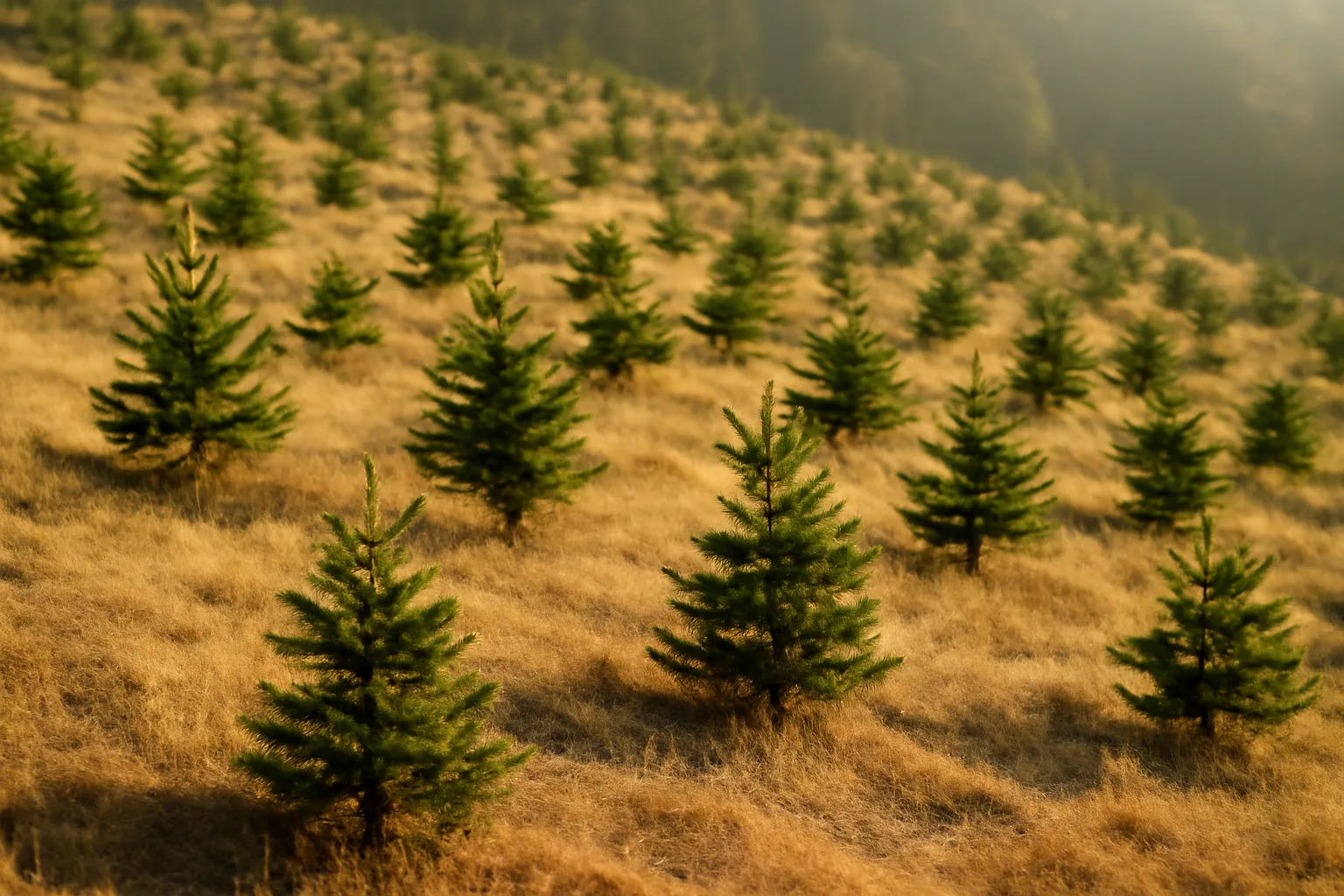
Think $6,000 to $10,000 per planted acre before you sell a single California tree, with 6 to 8 years to first harvest. California adds water, irrigation, and local permit costs. You need a CDFA nursery stock license if you sell trees and a free CDTFA seller's permit. No state choose-and-cut license exists. Verify fees with the boards.
How much does a Christmas tree farm cost in California?
Think $6,000 to $10,000 per planted acre before you sell a single tree, plus California-specific water, land, and permit costs. A five-acre starter can realistically run $50,000 to $100,000 across the first rotation, but no state agency publishes one price list [7].
UMN's small-farm guide puts bare establishment at $6,000 to $10,000 per acre over the first full rotation, not counting land or irrigation [7]. California rarely matches that low end unless the property already has an agricultural well, drip system, and flat or gentle terrain. On raw foothill ground, the real startup number moves up fast.
A one-acre block at 6x6 foot spacing needs 1,210 seedlings. At the standard 5x5 spacing, the count jumps to 1,742 trees per acre [6]. Seedling cost varies by species and order size, so get a written nursery quote before you finalize your loan. The point is not the exact seedling bill; it is that your acreage, spacing, and water setup control the total far more than the state license fee does.
Budget the license as a rounding error. The expensive line items in California are land, water development, irrigation parts, labor for shearing, and rodent or weed control over six to eight years [6][8].
Do you need a license for a Christmas tree farm in California?
Yes, if you sell trees. California law treats field-grown Christmas trees as nursery stock, and no person may sell nursery stock without a valid CDFA license [1]. A private family cutting a tree for home use does not need that license.
For a choose-and-cut or retail lot, you also need a CDTFA seller's permit because you are selling tangible goods. That permit is free, though CDTFA may require a security deposit [2]. The CDFA nursery license and the seller's permit are separate. One does not replace the other.
Do not confuse this with a USDA Forest Service Christmas tree cutting permit. That is a recreation permit for cutting a wild tree on federal land. A planted farm sold on private land uses the CDFA nursery route, not the Forest Service permit route.
Confirm the current CDFA nursery fee to the dollar before you file. The state sets fees in regulation, and county agricultural commissioners may add inspection fees [3].
What local permits and zoning affect a California Christmas tree farm?
County zoning is the paper that can stop a project before it starts. Agricultural zoning often allows a small choose-and-cut retail season, but residential, timber, or preserve zonings may require a conditional use permit, a site plan review, or a public hearing. The CDFA license does not preempt local zoning [3].
Start at the county planning department, not the state. Ask for the specific code section that allows agricultural retail. If the phrase christmas tree farm does not appear, ask whether it falls under agricultural processing, roadside stand, or agritourism. Get the answer in writing.
Water adds a second local paper layer. A surface diversion for irrigation needs a water right or a small domestic or stock water use registration with the State Water Resources Control Board [5]. A new well may require a county environmental health permit. Your local agricultural commissioner can tell you which of these apply to your parcel.
In high-fire-risk counties, you may also need a driveway turnout plan, parking surface, and portable restroom agreement before you open. These are not Christmas tree permits. They are the local conditions that turn a $10,000 planting into a $40,000 seasonal business.
How long does a Christmas tree farm take in California?
Plan on six to eight years from transplant to first retail cut for Douglas-fir, the workhorse species in many California foothill and mountain districts [6]. Monterey pine on the central and south coast can reach choose-and-cut size a year or two earlier, but it needs the right coastal influence and can be more sensitive to inland heat.
Add a full year before planting for licensing, zoning, water improvement, and site prep. A realistic timeline is: year 0, paper and water; year 1, plant; years 2 through 5 or 6, mow, irrigate, and shear; years 6 to 8, first sales.
Spacing changes when that first sale arrives. The 5x5 foot spacing produces more trees per acre but more shearing and less air movement. The 6x6 spacing produces 1,210 trees per acre and generally makes a better first-time block because you can walk the rows easily with a mower [6].
If you are borrowing money, use the eight-year end of the range for cash-flow planning. A fast five-year estimate is a plan for a cash crunch.
What are the real startup cost buckets in California?
The three California extras are water, permits, and pest pressure. The bare $6,000 to $10,000 per acre from University of Minnesota covers planting, basic weed control, and shearing before first sale [7]. It does not include a well, pump, filtration, buried main line, or drip tape.
In many California foothill parcels, a drip system for one acre runs $2,000 to $5,000 installed, but that is a broad planning range, not a bid. Get three irrigation quotes after your water source is confirmed. A pump that must lift water 300 feet costs far more than a gravity-fed line from an existing ag ditch.
Pest control is not optional in most of California. Ground squirrels, gophers, and deer can kill young trees in year one, and white pine weevil or aphids can deform leaders in later years [8]. Budget for tree guards, bait stations, and at least one scouting pass per month during the growing season.
Labor for shearing is the hidden annual line. Douglas-fir and most true firs need an annual leader and shape cut. A hired crew can cover an acre in a day or two, but hand pruning skill affects sale price more than any other single variable [6].
What does land and water do to California Christmas tree farm cost?
Land and water decide whether the California number looks like $8,000 or $40,000 per acre before you open. No state website will tell you your parcel-specific answer. A property with three-phase power, an existing ag well, and a proven irrigation system is a different business than raw oak woodland with seasonal creek access.
Surface water is not there for the taking. A diversion generally needs a water right. The State Water Board process is not a one-page form for a new commercial operation [5]. If you are buying land, make the water right or existing well permit a closing condition, not a discovery project.
Groundwater is regulated differently under the Sustainable Groundwater Management Act. In many basins, a new agricultural well may require a county permit and a meter. Ask the local Groundwater Sustainability Agency before you assume a new well is legal.
The practical test: if the property cannot support one acre of orchard or vineyard without new water, do not assume Christmas trees will be cheaper. Christmas trees use less water than almonds, but a new planting still needs consistent moisture through the first three summers.
Which species make economic sense in California?
Douglas-fir is the safest first choice for most California mountain, foothill, and North Coast districts. It tolerates cool winters, shears into a classic shape, and has an established retail market [6]. Monterey pine works on coastal terraces from about Santa Cruz to San Luis Obispo and can reach first sale faster, but it is not a desert or hot Central Valley tree.
Red fir and white fir can work at higher elevations. Nordmann and Turkish fir are grown by a few California farms for premium choose-and-cut markets, but they cost more as seedlings and may need more careful site selection. Do not plant noble fir below its elevation comfort zone. It will grow slowly and disappoint buyers.
Plant at least two species, not because of a rule, but because one bad spring or one new pest can ruin a single-species block. A two-species planting also spreads your harvest window and gives customers a reason to visit twice.
Match the species to your winter chill hours, not to a national article. A quick call to your local UC Cooperative Extension farm advisor can save the full first-year planting investment [8].
What equipment can you skip in year one in California?
Skip the tree spade, baler, and retail barn in year one. A first-year California block needs a mower or brush hog, a backpack sprayer, hand pruners, tree guards, irrigation repair parts, and a used truck or ATV if the rows are long.
Do not buy a tractor in the first year for five acres or fewer. Hire out initial ripping, discing, and post-hole digging. Once you know the block drains properly and the water works, a compact tractor becomes a useful but not required purchase in years three to five.
Spend on irrigation filters and pressure regulators before spending on a baler. A failed drip system in a California August kills more young trees than any missed shearing pass. The cheapest insurance is a spare filter, spare emitters, and a written irrigation schedule.
If a vendor tells you that you need a commercial walk-in cooler for cut-your-own, walk away. Most California choose-and-cut operations cut trees fresh at the field and sell them same-day. Cold storage matters for pre-cut lots, not for a startup choose-and-cut block.
What paperwork does a California choose-and-cut farm need before opening?
Before the first customer parks, have four papers in the folder: the CDFA nursery stock license, the CDTFA seller's permit, the county zoning or conditional use permit, and the water source document [1][2][3][5]. Add a pesticide operator identification number or certified applicator if you use restricted materials [4].
California seller's permit is free, so file it early [2]. It also gets your resale record and sales tax filing started. If you sell a tree and collect sales tax without a permit, you have a fixable but annoying CDTFA problem.
A $149 Shear-Year + Choose-and-Cut Kit from ChooseAndCutPath helps build the board-confirmable checklist, but it does not replace the filing itself. Buy the kit as a paper resource, not as legal advice.
Insure before you open, not after. A visitor falling in a field, a tractor accident, or a saw injury is a liability line. Farm and ranch liability with a choose-and-cut rider is often less expensive than fixing an uninsured accident later.
How do you price a California choose-and-cut tree?
A realistic California choose-and-cut price is the local pre-cut lot price plus 10 to 30 percent, because the customer gets an afternoon, a fresh cut, and the tree they pick. The national average retail tree price sits around $80 to $100, but metro California lots and premium species can run far higher [9].
Price by species and height band, not by a single trunk price. A 5 to 6 foot Douglas-fir may sell for one number. A 7 to 8 foot Nordmann can command a premium in the Bay Area market. Post a simple board price before the season opens and keep the sales pitch to one page.
Never price your first harvest below a simple replacement calculation: what it costs to buy, plant, water, shear, and hold that tree to sale, plus a margin for the five years of zero revenue. Many first-time farms underprice because they forget the zero-revenue years.
If retail competition pushes prices down, sell a limited number of pre-cut trees and keep the choose-and-cut block focused on species that local lots do not carry. Differentiation is easier than a price war.
Where should you confirm current California fees before you write a check?
Confirm the CDFA nursery license fee, county inspection charges, and any local agritourism fee before you budget. These are the numbers that change without a headline. The correct source is the specific program, not a national article.
CDTFA's seller's permit is free, but the agency may require a security deposit. The CDFA nursery fee is separate and set by regulation. Ask the Nursery Services Program for the current fee schedule and whether a location fee applies to each sales site [2][3].
For water, the State Water Board fee schedule and your local groundwater sustainability agency fee are separate items [5]. A pesticide operator certificate or applicator fee from DPR may also apply if you use restricted materials [4].
ChooseAndCutPath's $149 kit is a paper path, not a law firm and not a state filing service. Use it to checklist the confirmations. File the actual forms with the board that issues them.
How does California compare with other states on startup cost?
California is not the worst state for a first Christmas tree farm, but water and land push it above the Southeast in entry cost. Alabama can bring Virginia pine to first sale in four to six years, which is faster cash flow than a Sierra foothill Douglas-fir rotation Alabama. Arkansas and Georgia offer lower land and more rainfall in most years.
Compare the full link set to understand the pattern. Arizona shares the water problem but adds more extreme summer heat Arizona. Colorado has rocky mountain soils and a shorter high-elevation season Colorado. Idaho has good intermountain soil but a smaller retail base Idaho. Hawaii is a special import, with ideal fall weather but expensive freight and land Hawaii.
California's advantage is a huge urban retail base, a strong choose-and-cut tradition, and dry summers that reduce needle cast disease in many districts. If your parcel already has water and agricultural zoning, the state can support a profitable long-rotation farm.
If you are choosing between sites, compare water first, soil second, and romantic mountain views last.
Frequently asked questions
Do you need a license for a Christmas tree farm in California?
Yes, if you sell trees. California treats field-grown Christmas trees as nursery stock. You need a CDFA nursery stock license under Food and Agricultural Code Section 6711. You also need a California seller's permit because you are selling tangible goods. A family cutting a tree for home use does not need the CDFA license.
How much does a Christmas tree farm cost in California?
Budget $6,000 to $10,000 per planted acre before the first sale, not counting land, water development, or local permit upgrades. A five-acre starter on raw foothill ground can run $50,000 to $100,000 or more across the first rotation. The bare budget number comes from University of Minnesota Extension.
How long does a Christmas tree farm take in California?
Plan on six to eight years from transplant to first harvest for Douglas-fir. Monterey pine on the central and south coast may reach sale size a year or two earlier. Add one additional year before planting for licensing, zoning, water improvement, and site prep.
Can you sell Christmas trees without a license in California?
No, not legally. Selling nursery stock without a valid CDFA license is unlawful under California Food and Agricultural Code Section 6711. If you sell directly to customers, CDTFA also requires a seller's permit. Operating as a choose-and-cut farm without these papers creates state and county enforcement risk.
What is the cheapest Christmas tree species to grow in California?
Douglas-fir is the most dependable low-cost first choice for most mountain, foothill, and North Coast districts. Monterey pine can be cheaper in labor on the central and south coast because it reaches sale size faster. The wrong species for your heat or chill zone is the expensive one.
How many trees per acre for a Christmas tree farm?
At 6x6 foot spacing, plant 1,210 trees per acre. At 5x5 foot spacing, plant 1,742 trees per acre. Wider 7x7 spacing gives 889 trees per acre. Most first-time choose-and-cut blocks do better at 6x6 because the rows are easier to mow and walk.
Do you need a water right to start a Christmas tree farm in California?
For surface water diversion, generally yes. The State Water Resources Control Board requires a water right or registration for irrigation diversions. Groundwater is regulated under SGMA. A new agricultural well may need a county permit and a meter in some basins. Confirm with the local Groundwater Sustainability Agency.
Can you start a Christmas tree farm on 1 acre in California?
You can, but the economics are thin. A one-acre Douglas-fir block has about 1,210 trees at 6x6 spacing, but you will spend six to eight years on water, shearing, and pest control before a full retail season. Five acres or more is better for cash flow and customer traffic.
How much does a California seller's permit cost for a Christmas tree farm?
A seller's permit from CDTFA is free. CDTFA may require a security deposit in some cases, but the permit itself has no fee. File it before you collect sales tax on trees, wreaths, or other tangible goods sold at the farm.
What is the first year cost of a California Christmas tree farm?
The first year is mostly site prep, seedlings, planting, tree guards, and initial irrigation. Inside the $6,000 to $10,000 per acre rotation budget from University of Minnesota Extension, first-year cash out is often $1,500 to $3,000 per acre, but water and fencing can add substantially on California land.
Do Christmas tree farms pay property tax in California?
Many California counties offer lower agricultural assessments, sometimes through a Williamson Act agricultural preserve contract. Eligibility depends on parcel size, zoning, and commercial use. The county assessor decides whether your tree planting qualifies. Do not assume a lower tax rate without a written determination.
What insurance do I need for a California choose-and-cut farm?
General farm liability with an agritourism or choose-and-cut rider is the minimum before opening to customers. If you hire employees, California requires workers' compensation coverage. A saw injury or a visitor fall is common. Insurance costs less than an uninsured accident.
Sources
- California Food and Agricultural Code, Section 6711: Selling nursery stock without a valid CDFA license is unlawful. Field-grown Christmas trees are nursery stock when sold.
- California Department of Tax and Fee Administration: A California seller's permit is free, but CDTFA may require a security deposit.
- California Department of Food and Agriculture, Nursery Services Program: CDFA issues nursery stock licenses and sets fees by regulation. Counties may add agricultural inspection fees.
- California Department of Pesticide Regulation, Licensing and Certification: People applying restricted pesticides on farms must hold a pesticide applicator certificate or license.
- State Water Resources Control Board, Water Rights Frequently Asked Questions: Surface water diversion for irrigation needs a water right. Groundwater regulation under SGMA may require permits or meters.
- Pacific Northwest Extension, Growing Christmas Trees in the Pacific Northwest, PNW 6: Douglas-fir rotations run 6 to 8 years. Monterey pine reaches sale size faster. Publication includes planting density and shearing guidance.
- University of Minnesota Extension: Startup cost is $6,000 to $10,000 per acre before the first sale, excluding land and irrigation.
- UC Statewide IPM Program, Christmas Tree Pest Management Guidelines: California Christmas tree farms need regular scouting for gophers, squirrels, aphids, and white pine weevil.
- National Christmas Tree Association, Quick Tree Facts: Average real Christmas tree retail price is around $80 to $100.