Last updated 2026-08-18
TL;DR
Starting a Christmas tree farm in Arizona costs roughly $2,000, $5,000 per acre over a 5 to 8 year rotation, mostly in seedlings, irrigation, and labor. You don’t need a special Christmas tree license, but you must secure a transaction privilege tax license, a well permit if using groundwater, and a pesticide applicator certification if you spray. Expect a long wait before any revenue.
Is a Christmas Tree Farm Even Viable in Arizona?
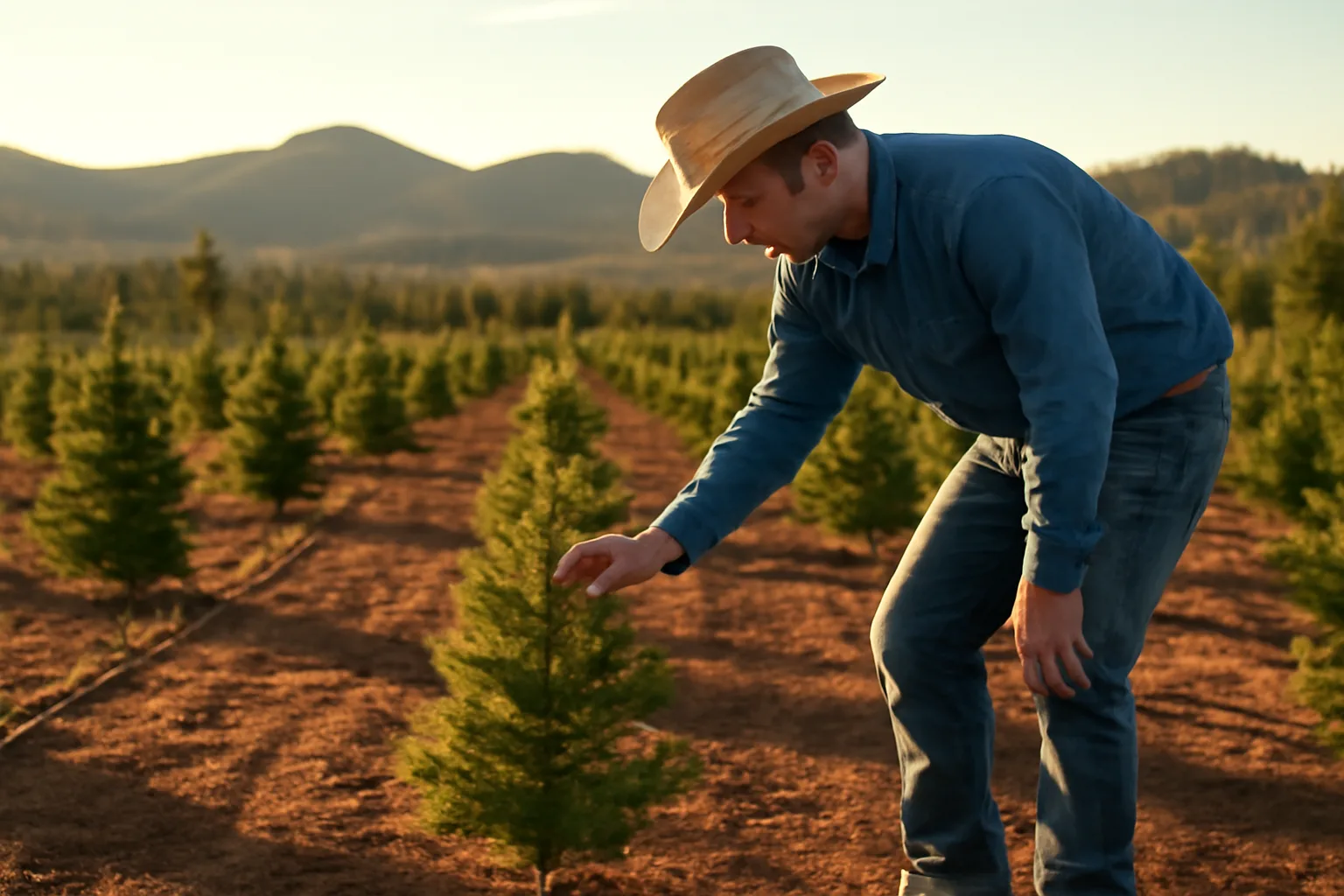
It depends where you are. Arizona’s record heat isn’t a myth. In Phoenix or Tucson, you can forget growing any conifer that makes a decent Christmas tree. But drive two hours north to the Mogollon Rim, the White Mountains, or the Flagstaff area, and the elevation buys you cooler nights, snow, and a viable microclimate. The 2017 USDA Census of Agriculture counted exactly four Christmas tree farms in the entire state, on 149 acres total [1]. That’s tiny. And it tells you something.
That said, four farms are selling trees and staying alive. So it’s not impossible. The flag that should go up is the water and the species list. You aren’t growing Fraser fir here. You’ll be picking from a shortlist of heat-tolerant evergreens: Afghan pine (Pinus eldarica), Arizona cypress (Cupressus arizonica), and maybe deodar cedar if you’re above 5,000 feet. The University of Arizona Extension’s publication on Christmas tree selection in Arizona makes this brutally clear: “Species that require substantial chilling hours, such as Douglas fir, will not survive in the low desert.” [2]
If you have land in northern Gila County or Apache County, your odds improve. If you’re looking at agricultural land around Willcox, where the water table is dropping, your costs will skyrocket. This guide walks you through what every prospective Arizona grower needs to see on paper before buying a seedling.
What Does It Really Cost to Start?
Nobody has published an Arizona-specific Christmas tree cost budget. The closest apples-to-apples data I trust comes from Mississippi State University Extension. Their “Costs and Returns for Christmas Tree Production” (Pub. 2204) estimates a first-year establishment cost of $2,411 per acre [3]. I’ve used that as a floor and added Arizona’s water and fencing premiums, which I’ll explain. In practice, budget $2,000 to $5,000 an acre to get from bare dirt to a planted, irrigated field.
Here’s how that Mississippi State number breaks down, with my annotations for Arizona:
- Trees (1,200 seedlings at 52 cents): $624. In Arizona, you’ll likely pay a bit more for heat-tolerant species, maybe 75 cents to $1 each, so bump that to $900.
- Land preparation (plowing, disking, layout): $125. Arizona’s caliche soil may require a dozer, doubling this to $250.
- Chemicals and fertilizer: $242. Same ballpark.
- Labor for planting: $450. Plan on $500 if you can’t find volunteer labor.
- Fixed costs (irrigation infrastructure, taxes, insurance): $785. This is the big variable. Drip irrigation for an acre can run $1,000. A well pump and filter station add thousands. If you already have a permitted irrigation well, you save a bundle. If you need to drill a new one, figure $15,000 to $30,000 just for the hole and casing, and that doesn’t show up in the per-acre figure because it spreads over many acres.
Bottom line: $2,400/acre is the optimistic, water-ready startup. The real first-check write might be $4,000/acre once you factor in the well, a storage tank, and a deer fence. I include a chart below that shows the base Mississippi budget, but treat it as a starting point and add your water number.
If you’re staring at land that doesn’t have a grandfathered irrigation right, stop here and re-read the water section. This is where most Arizona dreams die. If you’re comparing mountain-region costs, our Colorado and Illinois guides show a similar range but with different water law.
How Much Land Do You Need in Arizona?
You can start a small choose-and-cut plot on five acres. That’s common in other states, and it works here if you’re near a population center like Prescott or Show Low. Standard spacing is 5 ft by 6 ft, or about 1,450 trees per acre, though many growers plant 6x6 to allow for equipment. With survival rates of 80 percent, five acres gives you roughly 5,800 saleable trees at the end of the rotation. That’s a solid weekend business.
If you want to quit your day job, the number I hear from full-time tree farm operators in the Rocky Mountain West is 20 to 40 acres under management, in various stages of growth. That keeps you in trees every year after the first rotation. Arizona’s land market is all over the map. Raw land with a shared well in Apache County can go for $1,000 an acre. A 10-acre parcel in Coconino County with a house and good water might run $200,000. My rule of thumb: land cost matters less than water rights. Buy land that already has a producing irrigation well.
Which Tree Species Survive the Arizona Heat?
The University of Arizona Extension says it straight: you’re choosing between Afghan pine (Eldarica pine), Arizona cypress, and a few other tough conifers [2]. Afghan pine is your bread and butter. It grows fast, handles heat, and looks the part. Arizona cypress is the native choice; it has a bluish-green color and a strong lemon scent, but some customers are thrown off by that. Deodar cedar works above 4,500 feet but is slower. Some growers in the high country have tried Scotch pine and even white fir with success, but they require colder winters.
Fraser fir and Noble fir, the premium species that fetch $100+ per tree on Oregon lots, simply won’t live here. The chronic heat and low humidity in summer push them into budworm and needle cast. Stick with what survives. Your first few years will be an experiment in microclimates anyway.
Do You Need a License for a Christmas Tree Farm in Arizona?
There is no “Christmas tree farm license” in Arizona. But you do need three things before you sell the first tree or spray anything:
1. Transaction Privilege Tax (TPT) license. If you sell directly to customers at a choose-and-cut operation, the Arizona Department of Revenue requires a TPT license. You can apply online, and there’s a small fee. Without it, you’re selling illegally. [8] 2. Pesticide applicator certification. Any person who uses a restricted-use pesticide must be a certified applicator, according to the Arizona Department of Agriculture [4]. Even if you stick with over-the-counter products, you need to know what’s legal. The certification exam costs $50 for a private applicator. 3. Well permit (or proof of water right). If you’re pumping groundwater from a well with a capacity over 35 gallons per minute, the Arizona Department of Water Resources requires a well permit [5]. Drilling a new well in an Active Management Area adds layers of review.
You don’t need a nursery license if you’re solely growing trees for cut-your-own sales, because you aren’t selling live plants for transplanting. But if you ever bring in out-of-state liners and resell them, you might trigger the Plant Services Division’s nursery licensing requirements. Confirm with the Arizona Department of Agriculture directly.
Water Rights: The Real Showstopper
Arizona water law is not intuitive. The state operates under prior appropriation: first in time, first in right. That means your ability to irrigate 10 acres of trees depends on whether you have a grandfathered irrigation right, a well that predates the 1980 Groundwater Code, or you’re in an area where you can pump a small amount without a claim.
For a new operation, your path is usually a well with a capacity of less than 35 gallons per minute, which doesn’t require a full ADWR permit in many areas, only a notice of intent to drill, or you buy into a community water system. But a 35-gallon-per-minute well can irrigate maybe 2 to 3 acres at best with drip, and that’s if you run it all day. Five acres of Christmas trees in the high desert can consume 2 to 3 acre-feet per year. That’s roughly 650,000 to 1 million gallons annually.
I’ve watched a would-be grower near Kingman plow $50,000 into a well only to find the static water level at 600 feet, with poor recovery. Don’t buy land until a licensed well driller has given you a water availability report. It’s the one pre-purchase step you can’t skip in Arizona.
How Long Before You Can Sell a Single Tree?
Five to eight years. That’s the honest window.
Afghan pine can reach 6 to 7 feet in five years under good irrigation and a solid fertility program. Arizona cypress takes six to seven years. Deodar cedar might push eight. If you try Scotch pine in a high-elevation site, plan on seven. The University of Georgia Extension, which deals with heat in its own way, pegs the timeline at 6 to 8 years for most southern pines [6]. Arizona, with a longer growing season but more water stress, sits in a similar range.
You can shave a year off by planting larger transplants (2-0 or 3-0 stock), but you’ll pay more per seedling and risk higher loss from transplant shock. The timeline is why cash flow planning matters: you’ll have zero tree revenue for roughly half a decade. Many Arizona growers run a side hustle, cut hay, pumpkins, or agritourism, while the trees mature.
Annual Operating Costs After the First Year
Once the trees are in the ground, you’re not done writing checks. Shearing, mowing, spraying, fertilizing, and irrigating each acre costs around $500 to $1,000 a year, using the same Mississippi State budget scaled for Arizona’s longer irrigation season. Here’s a rough line-item view:
- Shearing (annual shaping): $0.25 per tree, or $300 per acre.
- Mowing and weed control: $150.
- Irrigation water and electricity: $200 (wildly variable).
- Fertilizer: $100.
- Pest and disease scouting: $50 if you do it yourself.
- Labor: $300.
That’s $1,100 total per acre per year before fixed costs. If you do everything yourself except the heavy lifting, you might hold it to $700. But if you’re paying for labor and have to pump from a deep well, your power bill alone can hit $100 an acre per month in the summer. Don’t let the $500 number lull you.
How Much Can You Actually Make?
The math works if you hold costs flat and survive the rotation. The National Christmas Tree Association reported an average choose-and-cut retail price of $76 per tree in 2022 [7]. If you plant 1,200 trees per acre and achieve 80 percent survival, that’s 960 saleable trees. Gross revenue per acre: $72,960, but spread over six or seven years.
When I run a pro forma for a five-acre Arizona start-up with a $4,000 first-year cost per acre and $1,000 annual operating cost per acre, the cumulative cash outlay over seven years approaches $70,000 before you sell a single tree. After you sell the first rotation, you might net $40,000 to $60,000 on five acres, depending on how many you wholesaled versus sold at retail. That’s around $8,000 to $12,000 a year averaged over the rotation.
It’s not a calamity. It’s a long game. And if you overestimate survival or underestimate water, you’ll lose money.
Common Ways Arizona Tree Farms Fail
The graveyard of Christmas tree farms in Arizona is full of people who thought they could water from a pond that dried up in June, skipped the pesticide certification and got a stop-sale order, or bought a hundred acres of raw land without checking the well’s output. I’ve also seen good operators struggle because they picked a species that couldn’t handle a triple-digit heat wave.
The four things I’d double-check this afternoon if I were starting:
1. Water availability report from a driller, not a real estate agent. 2. Pesticide certification scheduled before you need it, it takes weeks to process. 3. TPT license on file; Arizona is aggressive about sales tax audits. 4. Species trial on a quarter acre before you plant 10 acres.
That last one is free advice. Plant a test block with three different species. Wait two summers. Then scale what lives.
One resource that speeds up the paper portion is a pre-built plan. ChooseAndCutPath sells a $149 Shear-Year + Choose-and-Cut Kit that includes a board-ready operations plan and a choose-and-cut layout template. It’s not a replacement for a lawyer, but it gets the farm’s bones onto paper faster. (Full disclosure: I write for ChooseAndCutPath, so this is our own toolkit.)
How Arizona Compares to Other States
If you’re on the fence about where to set up, the cost columns shift rapidly by region. In California, land prices and water rights can push startup past $8,000 an acre. Colorado’s shorter growing season forces longer rotations but lower water costs, as our Colorado guide details. Idaho’s cold-hardy species market is more established, and the Idaho numbers reflect that. Meanwhile, Illinois with its clay soils has a completely different set of cost drivers. Our Illinois breakdown is eye-opening. Before you commit, grab our $149 kit; it’s the quickest way to a board-ready paper trail.
Frequently asked questions
Do you need a license for a Christmas tree farm in Arizona?
There is no singular “Christmas tree farm license.” You need a Transaction Privilege Tax (TPT) license from the Arizona Department of Revenue if you sell trees at retail. If you apply any restricted-use pesticide, you must hold a private applicator certification from the Arizona Department of Agriculture. And if you pump from a well with more than a 35‑gallon‑per‑minute capacity, you likely need a well permit from the Arizona Department of Water Resources.
How much does a Christmas tree farm cost in Arizona?
Plan on $2,000 to $5,000 per acre for the establishment year, including seedlings, land prep, irrigation infrastructure, and labor. That does not include drilling a new well, which can run $15,000 to $30,000. Annual operating costs run $500 to $1,000 per acre thereafter. A five‑acre start‑up can easily require $50,000 to $100,000 in total cash outlay before the first harvest.
How long does a Christmas tree farm take in Arizona?
Most species reach a saleable 6‑ to 7‑foot height in five to eight years after planting. Afghan pine can be ready in five years under good conditions; Arizona cypress takes six to seven years; deodar cedar may need eight. You will have no tree revenue during that entire establishment period.
What is the best Christmas tree to grow in Arizona?
Afghan pine (Pinus eldarica) and Arizona cypress (Cupressus arizonica) are the two most reliable species for Arizona’s low and mid‑elevation areas. Afghan pine grows fastest and tolerates heat. Arizona cypress is native, drought‑tolerant, and has a distinctive bluish color. At elevations above 5,000 feet, some growers have success with Scotch pine and white fir.
Do I need a well permit for a small Christmas tree farm?
If your well pump can produce more than 35 gallons per minute, you must obtain a well permit from the Arizona Department of Water Resources. For a small operation of two or three acres, a well that stays under that threshold may only require a notice of intent to drill. Always confirm with ADWR before drilling.
Can I start a Christmas tree farm in the Phoenix area?
Realistically, no. The extreme heat, low humidity, and intense summer sun kill or severely stress most Christmas tree species. Even Afghan pine, the most heat‑tolerant species, would require huge amounts of water and still likely produce poor‑quality trees. The high‑country regions around Flagstaff, Show Low, Pinetop, and the White Mountains are the only viable zones.
Is there a market for choose-and-cut trees in Arizona?
Yes, particularly in mountain communities like Prescott, Flagstaff, Show Low, and the White Mountains. Families value the experience and typically pay $70 to $90 per tree. The market is small but fiercely loyal, and many growers sell out on two or three weekends each December.
Do I need insurance for a Christmas tree farm?
If you invite the public onto your property for a choose‑and‑cut operation, you absolutely need commercial general liability insurance. A typical agritourism policy for a small farm runs $500 to $1,200 per year. Your standard homeowner or farmowner policy will not cover injuries to paying visitors.
How many trees can I plant per acre in Arizona?
Planting at a 6x6‑foot or 5x6‑foot spacing gives you 1,000 to 1,200 trees per acre. In Arizona, I’d lean toward the lower end, because tighter spacing increases competition for water and raises stress during dry spells. High‑density plantings are an avoidable risk.
What’s the biggest mistake new Arizona tree farmers make?
Assuming they can irrigate from a seasonal creek or a shallow well without a permit or a real water‑availability study. Water is the fatal flaw. The second‑biggest mistake is planting a species that cannot handle the heat or dry air, then watching it decline over two seasons.
How do I sell Christmas trees in Arizona without a tax license?
You can’t legally. Any retail sale of tangible personal property in Arizona, including trees sold at a temporary lot or your farm gate, requires a transaction privilege tax (TPT) license from the Arizona Department of Revenue. Apply online before you open; the state audits aggressively.
Can I get a grant to start a Christmas tree farm in Arizona?
There are no grants specifically for Christmas tree farming. However, the USDA’s Environmental Quality Incentives Program (EQIP) sometimes helps with irrigation efficiency improvements on existing operations. Also, the Natural Resources Conservation Service (NRCS) has cost‑share programs for practices like drip‑to‑sprinkler conversion. Start with your local NRCS field office.
Sources
- USDA NASS, 2017 Census of Agriculture, Arizona, Table 35: Arizona had 4 farms growing Christmas trees on 149 acres in 2017.
- University of Arizona Cooperative Extension, AZ1769, Christmas Trees in Arizona: Selection, Planting, and Care: Species that require substantial chilling hours, such as Douglas fir, will not survive in the low desert.
- Mississippi State University Extension, Publication 2204, Costs and Returns for Christmas Tree Production in Mississippi: First‑year establishment cost estimated at $2,411 per acre.
- Arizona Department of Agriculture, Pesticide Applicator Certification: Any person who uses a restricted‑use pesticide must be a certified applicator.
- Arizona Department of Water Resources, Well Permitting: A well permit is required for wells with a pump capacity greater than 35 gallons per minute.
- University of Georgia Extension, B 1461, Establishing a Christmas Tree Plantation: Most species take 6 to 8 years from planting to marketable height.
- National Christmas Tree Association, Quick Facts: The average price of a real Christmas tree was $76 in 2022.
- Arizona Department of Revenue, Transaction Privilege Tax (TPT) License: Every person who sells tangible personal property at retail must obtain a TPT license.