Last updated 2026-08-21
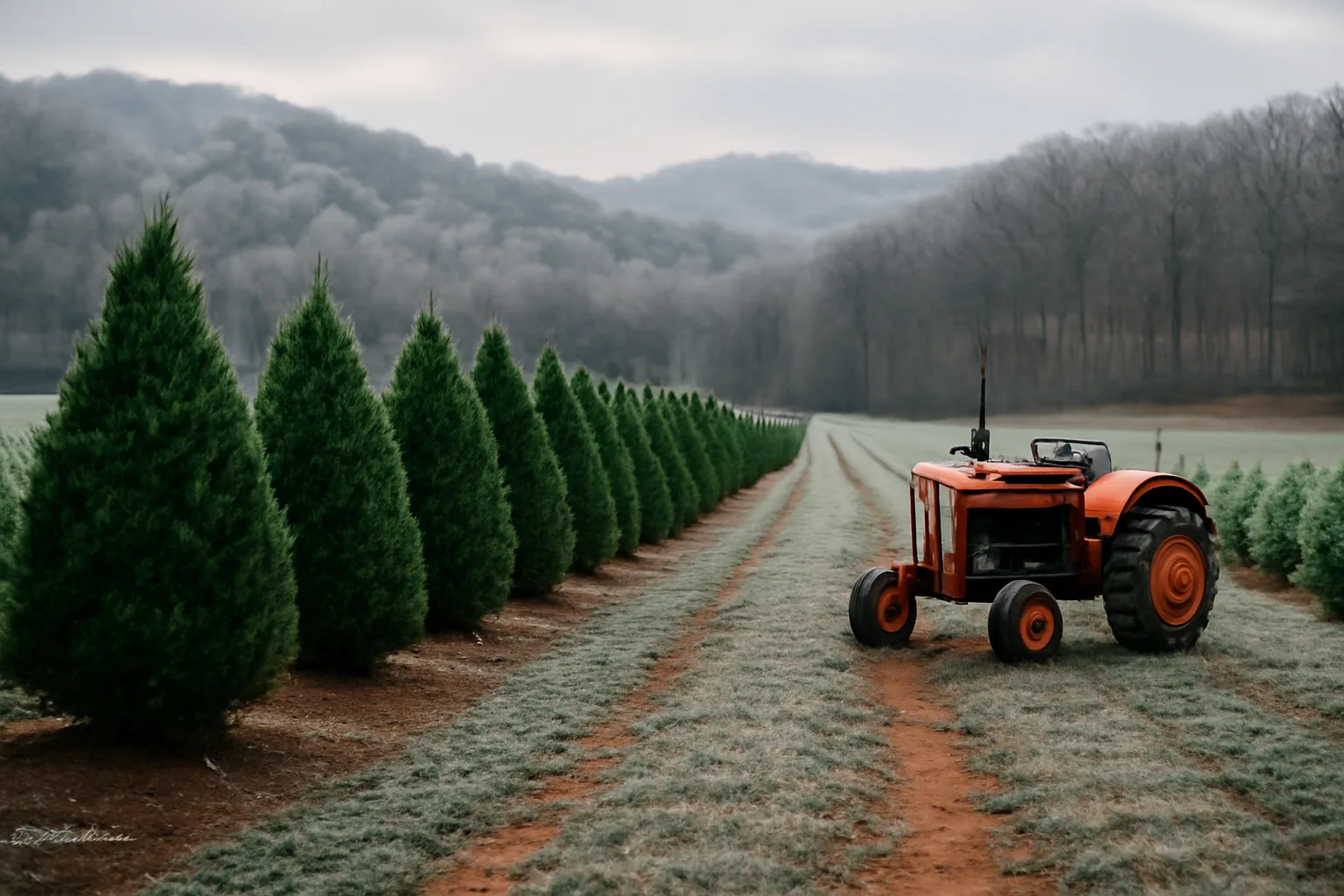
TL;DR
A Georgia Christmas tree farm costs more in land, idle years, and equipment than in state licenses. There is no single farm license to wait on. You still do local business tax, sales tax registration, and maybe live-plant paper. First cut is usually 4 to 8 years. On land you already own, year-one cash can be a few thousand dollars or tens of thousands if you buy iron.
How much does a Christmas tree farm cost in Georgia?
A Georgia Christmas tree farm costs whatever you pay for land, plus years of mowing, shearing, and tax with no tree revenue, plus the iron you actually need. On land you already own, a careful first planting stays in the low thousands of dollars. Buy a scenic north Georgia tract and a compact tractor before the first row lives, and you are in the tens of thousands with nothing to sell.
Nobody publishes a clean Georgia enterprise budget I would take to a lender. The closest honest method is to stack the USDA land figure, a UGA soil test, written seedling quotes, and local used-equipment prices, then add 4 to 8 carrying years.
USDA NASS put United States farm real estate at $4,170 per acre in 2024. [1] That Land Values report updates every August and includes a Georgia line. Statewide averages hide the market you will actually bid in. A cutover pasture in south Georgia and highway frontage outside Ellijay are not the same product. Read the current Georgia row in the NASS PDF, then get county digest comps.
If you already hold the land, year-one cash is site work, plants, and hand tools. Lime and fertilizer follow the UGA soil test, not a forum recipe. [8] Seedlings often sit well under $3 each, sometimes under $1, by species and size. At 6x6 feet you plant about 1,210 trees per acre. At 5x6 you plant about 1,452. Do that math before you brag about acreage.
The silent line is time. You fund a crop that will not ring a register for years. That carrying cost is the real Christmas tree farm cost in Georgia.
| Line item | Honest range | What I'd do |
|---|---|---|
| Already-owned land, 3 to 5 acres planted | A few thousand dollars in year one if you keep iron used or rented | Plant less than you think |
| Land purchase | Current USDA NASS Georgia figure plus local comps [1] | Do not offer the state average |
| Tractor and mower | Used often $15,000 to $35,000 on the open market | Rent or borrow until trees live |
| Irrigation | From nothing to a well and drip | Only after a drought plan |
| Public choose-and-cut extras | Insurance, parking, toilets | Budget these before ads |
I'd rather plant two clean acres well than ten acres I cannot shear.
Do you need a license for a Christmas tree farm in Georgia?
No single statewide "Christmas tree farm license" exists in Georgia. Growing trees for cut sale is farming. Selling to the public triggers local business paper, a sales tax account, and sometimes a live-plant license if your shed sells living plants.
Georgia Department of Agriculture Plant Protection licenses live plant growers and dealers under the live plant rules. [14] A cut Fraser or Leyland on a customer's roof is not potted nursery stock. People still get this wrong when they add living wreaths, potted rosemary, or balled pines next to the saws. Ask Plant Protection in writing about the mix you will actually sell. A Facebook group is not a waiver.
You will almost always need the county or city occupational tax certificate (the local business license) to take money from the public. Cobb County and Rabun County are not the same counter. Fees and forms change. Confirm with the clerk where the farm sits.
Retail tree sales generally need a Georgia sales and use tax account through the Department of Revenue. Trees sold at the farm are tangible personal property. Farm input exemptions cover a lot of what you buy. They are not a free pass on what you sell. Confirm your mix with DOR. I am not your preparer.
If you form an LLC, the Secretary of State lists the Articles of Organization fee on its formation how-to page. For a long stretch that number has been $100. Confirm the current amount before you file. [6]
Restricted-use sprays need a pesticide applicator credential from the Georgia Department of Agriculture. [12] General-use products are a different conversation. Labels change. Read the label and ask the pesticide division if you are unsure.
Zoning is the permit that blindsides people. Growing in an agricultural district is usually fine. A choose-and-cut lot, a gift shop, and weekend traffic can look commercial to a planner. Talk to the county planning office before you print flyers.
How long does a Christmas tree farm take in Georgia?
First harvest in Georgia is usually 4 to 8 years after a well-timed planting. Leyland cypress and Virginia pine come off earlier than white pine. Fraser fir in the mountains runs longer, often toward 8 to 12 years in southern extension guidance. [10] [11]
The clock starts at planting, not at the idea. Site prep can eat a season. Plant late, skip a year of shearing, or lose a drought block, and you added a year.
A real choose-and-cut farm needs more than one age class. Plant once and wait, and you get one crowded harvest and then a hole. I'd plant a block every year for at least five years. That means the place feels stocked closer to 8 to 10 years, not year four.
Paper is the short part. Entity, county tax certificate, sales tax account, insurance binder. Weeks if your file is complete. Longer if zoning fights you. Nobody honest can promise a processing time. The county and DOR run their own queues. Confirm, do not forecast.
Species choice is the long lever. Most of Georgia will not make a quality Fraser fir. That is climate, not grit. Check the USDA Plant Hardiness map for your exact spot before you order firs. [9] North Georgia mountains are a different farm than a field outside Tifton.
What does land and site prep cost in Georgia?
Land is the swing number. USDA's national farm real estate average was $4,170 per acre in 2024, and Georgia has its own row in that same table. [1] Tourism counties in the Blue Ridge charge a different price than row-crop ground in the south. Use the NASS figure as a compass, not an offer.
If you already own pasture, your cash cost is conversion. Soil test first through the UGA Agricultural and Environmental Services Labs. [8] Then lime, fertilize, and kill the weeds you actually have. Guessing lime is how you stall a stand for two years.
Site work I would budget as a wide per-acre band, often a few hundred dollars an acre if the field is already open, more if you are pushing brush, fixing drainage, or fencing deer. I have not seen a current Georgia-only published average I trust. Get two local dozer or bush-hog quotes.
Deer, feral hogs, and fire ants are not theoretical here. A pretty row with no fence can disappear. Walk the county and ask neighboring cattle people what walks that creek at night.
Irrigation is optional on some north Georgia clay and a survival tool on sand. Georgia EPD requires a water withdrawal permit once you average more than 100,000 gallons per day in a month. [7] Many small drip blocks never hit that. A big gun on a dry ridge might. Confirm the count method with EPD before you size a well as if permits were automatic.
Property tax can dwarf seedling cost over a decade. Georgia's Conservation Use Valuation Assessment (CUVA) is a 10-year agricultural covenant that can cut the digest value if the county treats the tract as bona fide conservation use. [5] Christmas trees can qualify. They do not qualify because you said so. The county board of tax assessors decides. Breach penalties are ugly. Read the covenant.
Which trees grow in Georgia and what do seedlings cost?
Georgia grows choose-and-cut trees. It does not grow every catalog picture. Leyland cypress, Virginia pine, Eastern redcedar, Arizona cypress types, and white pine in the north are the honest list. Fraser fir belongs on higher north Georgia ground, not on a coastal plain lot. [9] [10] [11]
Seedling price is a quote, not a statute. Private Christmas tree nurseries often land somewhere under $1 to a couple of dollars per plant, depending on species, plug versus bare-root, and how many thousand you take. The Georgia Forestry Commission sells reforestation seedlings, mostly pine and hardwood, with a public price list that changes. [13] Confirm the current sheet. Do not use last year's Facebook number.
| Species | Typical first harvest (southern extension ranges) | Georgia fit |
|---|---|---|
| Leyland cypress | About 3 to 5 years | Common on Georgia lots, watch canker |
| Virginia pine | About 4 to 6 years | Old Georgia standard, needle hold can disappoint |
| Eastern redcedar | About 5 to 7 years | Tough and native, not everyone's indoor tree |
| Eastern white pine | About 6 to 8 years | Better in north Georgia |
| Fraser fir | About 8 to 12 years | Mountains only |
I'd plant the species your customers already drive to buy, on ground that species can finish. A cheap fir seedling that dies in year two is not cheap.
Leyland has paid a lot of Georgia mortgages and has also melted in spots from Seiridium canker. Virginia pine made this state's Christmas tree reputation and still sheds faster than people want. Redcedar is the plant that lives when you neglect it. White pine wants cooler air. Match the tree to the county, not to a catalog from Oregon.
What equipment do you actually need in year one?
Year one you need a way to plant, a way to knock weeds and grass, and hand shears you will actually swing. You do not need a new compact tractor, a wagon ride, or a tree baler.
A used bush hog and a borrowed or rented tractor will establish a small block. Street prices for a used compact tractor in the South often sit in the mid five figures if you want something that starts. I would not spend that until I see survival after summer two. Renting is dull and correct.
Hand shears, a planting bar or auger, flagging, and a soil probe are the unglamorous kit. A backpack sprayer only if you know the product and have the credential you need. [12]
Skip the baler until you are selling cut trees in volume. Skip the custom gate until the trees have sides. Skip the point-of-sale iPad stack. A folding table and a numbered height list work while you learn whether anyone shows up.
If you already farm, you probably own 80 percent of this. If you do not, budget used iron and labor, not a showroom.
What taxes and farm exemptions apply to a Georgia tree farm?
Treat this as a farm with a retail door, not as a craft fair. Income and expenses generally live on a farm return. IRS Publication 225 is the manual I would actually read. [3]
Federal timber rules matter once trees are old enough. 26 U.S.C. § 631(a) states, "the term "timber" includes evergreen trees which are more than 6 years old at the time severed from the roots and are sold for ornamental purposes." [4] That election is a tax choice with basis and timing consequences. Use a CPA who has seen a Christmas tree return. Do not invent the election on a forum.
Georgia sales tax is the retail piece. Register if you sell to consumers. The agricultural exemption certificate is for qualifying inputs. It does not mean the tree leaving the farm is untaxed. Confirm current DOR treatment for your exact products, including wreaths and cocoa.
On the property side, CUVA is the Georgia tool most small bona fide farms ask about. It is a 10-year covenant administered at the county with state rules behind it. [5] Forest Land Protection Act covenants exist too, with different acreage logic. Neither one is automatic because you planted pines in a pretty row.
If you want a single folder of first-year paper tasks, ChooseAndCutPath sells a $149 one-time Shear-Year + Choose-and-Cut Kit. You can build the same list from the Georgia agencies cited here without it.
I would file the entity, the local business certificate, the sales tax account, and the soil test before I ordered 5,000 seedlings. The plants can wait a month. Bad paper cannot.
What insurance do Georgia choose-and-cut farms carry?
If strangers walk your rows with saws, you want general liability written for that, not a quiet farm policy that never heard of agritourism. I will not quote a premium. Markets move. Get two farm-insurer quotes and hand them your real site plan.
Hayrides, live wreath bars, and weekend food change the risk. Say those words out loud to the agent. A policy that covers trees and ignores the wagon is how people get surprised.
Georgia has agritourism liability statutes and posted-warning practice in the mix a lawyer would review. I am not that lawyer. If you invite the public, pay for a Georgia attorney to read your signs and your lease. Cheap signs copied from another state can be wrong.
Hire anyone and you have employment and possibly workers compensation questions. I will not guess you into a farm-labor exemption. Ask the State Board of Workers' Compensation or counsel. Seasonal cash pay without paper is how a fun December becomes a January problem.
Health permits sit with the county if you serve food. Hot cocoa is not always "just cocoa."
What does it cost to get from planting to first harvest?
The years between planting and first cut are the budget people skip. You will mow, shear, replant dead spots, and pay tax every season. None of that invoices a customer.
A crude way to see it: take your annual cash cost per planted acre (mowing fuel or custom work, a shearing pass, a little fertilizer, insurance share, property tax after any CUVA) and multiply by the years your species needs. [10] [11] Southern pines and cypress can be a 4 to 6 year bill. Firs are a longer bill.
Replants are not a footnote. First-year mortality of 10 to 30 percent is not rare when deer, drought, or bad handling show up. Budget extra seedlings in year two. The 2022 Census of Agriculture Georgia volume is where you look up how many Georgia operations even report cut Christmas trees, acres, and sales. Use that table. Do not trust a blog's farm count. [2]
Year of first harvest adds public costs. Parking, a safe entrance off a state route (GDOT cares about some driveways), toilets, saws, netting or a baler, card readers, and a denser insurance binder. That year can cost more in cash than year one even though the trees are "free" by then.
I'd keep a simple spreadsheet with one row per year and refuse to call the farm profitable until it has covered those mute middle years.
Can you start a Christmas tree farm on a few acres in Georgia?
Yes. Plenty of Georgia choose-and-cut places started as a back pasture and a handwritten height list. Two to five well-sheared acres near a weekend drive from Atlanta can out-earn twenty sloppy acres nobody can park on.
Density math still applies. Three acres at 1,200 living trees per acre is 3,600 trees, minus mortality, minus the ones you cut too early because you were excited. That is a real inventory if you planted in waves.
Small does not mean invisible to the county. You still have zoning, the occupational tax certificate, sales tax, and neighbors who did not agree to December traffic. A two-acre lot on a dirt road with no turnaround will make you famous in the wrong way.
I would not start a 2-acre fir dream on the coastal plain. I would start a 2-acre Leyland or cedar block on ground I already own, next to a road people already drive in December, and plant again next year.
What do new Georgia growers waste money on?
New iron before living trees. That is the classic burn. A tractor cannot shear for you and it cannot invent customers.
The second waste is the wrong species. Firs on hot sand. Unsheared white pine sold as "natural." A thousand Leylands under a center-pivot that slings phytophthora around. Match the USDA hardiness map and local lots you can walk. [9]
The third waste is destination theater in year three. Painted sheds, a maze, a drone video, and four age classes missing. Customers will forgive a gravel lot. They will not forgive a 3-foot "7-foot tree."
Skipping the soil test is a cheap way to stall. UGA's lab exists so you do not guess pH. [8]
I also see people over-plant the first Saturday they feel motivated. Then August happens. Plant what you can shear in a weekend. Hire help or plant less.
How does Georgia compare with nearby states?
Georgia sits between a real mountain fir culture to the north and heat that ends firs to the south. That is the whole strategic picture.
Alabama is the closest climate cousin for Leyland, cedar, and pine. If you want the neighbor's cost and paper path, read christmas tree farm cost in Alabama. Florida is harder on quality firs and easier on year-round growing weather. See christmas tree farm cost in Florida.
Arkansas is another inland southern comparison with cheaper land in many counties than north Georgia tourism ground. christmas tree farm cost in Arkansas is the sibling writeup.
California land and water rules are a different planet, useful only so you do not copy a West Coast budget. How much a Christmas tree farm really costs in California. Colorado has elevation and a fir habit Georgia only has in the mountains. Christmas tree farm cost in Colorado. For a Midwest choose-and-cut market contrast, christmas tree farm cost in Illinois is on the same shelf.
Georgia's edge is Atlanta weekend traffic into Gilmer, Union, Fannin, White, and Lumpkin counties. Georgia's trap is believing that traffic means any county and any species will work.
What should you confirm with the county and the state?
Confirm every variable number before you write a check. Boards change fees. This site does not.
Call or email Georgia Department of Agriculture Plant Protection with your product list and ask whether a live plant license applies. [14] Call the county clerk for the occupational tax certificate. Call planning for choose-and-cut, parking, and signs. Call the tax assessor about CUVA before you assume a 10-year covenant. [5]
Confirm the current LLC fee on the Secretary of State how-to page. [6] Confirm sales tax registration and any agricultural exemption use with DOR. Confirm pesticide credential needs with the Department of Agriculture. [12] Confirm irrigation against the EPD 100,000 gallon per day monthly-average threshold. [7]
Pull the newest USDA Land Values report each August and the Georgia chapter of the latest Census of Agriculture for cut Christmas trees. [1] [2] Pull a UGA soil test before lime. [8] Pull the GFC seedling list only if you are actually buying from GFC. [13]
If you want that folder in one kit, it is at /start. ChooseAndCutPath is an independent publisher, not a law firm and not a service company. No article can approve your farm or time your permit.
Frequently asked questions
Do you need a license for christmas tree farm in georgia?
There is no single statewide Christmas tree farm license. You still handle a local occupational tax certificate to sell to the public, a Georgia sales tax account for retail trees, and possibly a Department of Agriculture live plant license if you sell living plants. Restricted-use pesticides need an applicator credential. Confirm your mix with Plant Protection and your county clerk.
How much does christmas tree farm cost in georgia?
On land you already own, year-one cash can be a few thousand dollars if you plant a small block and rent iron. Buying land and a tractor pushes you into tens of thousands before any sale. USDA NASS put U.S. farm real estate at $4,170 per acre in 2024. Georgia's own figure is in that August report. The larger bill is 4 to 8 years of carrying cost.
How long does christmas tree farm take in georgia?
First cut is usually 4 to 8 years, shorter on Leyland or Virginia pine and longer on white pine or mountain fir. A stocked choose-and-cut farm with several age classes is closer to 8 to 10 years if you plant a block every year. Business paper is weeks to months. Nobody can honestly guarantee a county or state processing time.
Is a Christmas tree farm agriculture for Georgia property tax?
It can be, if the county board of tax assessors treats the tract as bona fide agricultural or conservation use. CUVA is a 10-year covenant that can lower digest value. Planting trees does not auto-qualify you. Ask the assessor before you count on the savings, and read the breach penalty language. Confirm current rules with the county and Georgia DOR.
Do you charge sales tax on choose-and-cut trees in Georgia?
Retail Christmas trees are generally taxable tangible personal property in Georgia. Register with the Department of Revenue if you sell to consumers. Agricultural exemption certificates are about qualifying purchases, not a blanket exemption on what leaves the farm. Confirm wreaths, food, and living plants as a separate mix. I am not your tax preparer.
Can you grow Fraser fir on a Christmas tree farm in Georgia?
Only in the cooler north Georgia mountains, and even there it is a long crop, often 8 to 12 years in southern extension ranges. Most of the state is too warm for a quality fir. Check the USDA Plant Hardiness map for your parcel. If you are south of the mountains, plant something that finishes, such as Leyland, cedar, or pine.
How many Christmas trees per acre should you plant in Georgia?
A 6x6 spacing is about 1,210 trees per acre. A 5x6 spacing is about 1,452. Leave room to walk, mow, and shear. Budget 10 to 30 percent first-year loss if deer or drought show up. I would rather have fewer living, sheared trees than a crowded acre I cannot work in August.
Do you need a pesticide license to spray Christmas trees in Georgia?
If you use restricted-use pesticides, yes, you need the proper Georgia Department of Agriculture applicator credential. General-use products follow the label and a different rule set. Labels and classifications change. Read the label and ask the pesticide division before you spray a row because a neighbor did.
Can you start a Christmas tree farm as a hobby on 2 acres in Georgia?
Yes, if the county allows the public use you want and you can shear what you plant. Two clean acres near a December drive can work. You still need local business paper and sales tax if you sell. Hobby intent does not erase zoning or liability. Plant species that finish in your county, not firs on hot sand.
What is the best area in Georgia for a choose-and-cut farm?
North Georgia tourism counties around Ellijay, Blue Ridge, Blairsville, and the Helen corridor already draw weekend cars and have cooler sites. That land costs more. South and middle Georgia can grow cypress, cedar, and pine, but you must create the trip yourself. Walk existing lots before you pick a county by Instagram.
Do wreaths and live potted trees change your Georgia licenses?
They can. Cut trees and living plants are not the same product under Plant Protection rules. Potted trees, living wreaths, and nursery stock are the items that push people into a live plant license. Describe the full December shed to the Department of Agriculture in writing. Do not assume the cut-tree answer covers the side table.
Is irrigation required for a Christmas tree farm in Georgia?
No. Many small farms establish on rainfall plus weed control. Sand, a high ridge, or a drought year can change that. If you pump a lot of water, Georgia EPD's withdrawal permit threshold is more than 100,000 gallons per day on a monthly average. Confirm how they count farm irrigation before you size a well.
Sources
- USDA NASS Land Values 2024: United States farm real estate averaged $4,170 per acre in 2024; the report also publishes a Georgia state average that updates each August.
- USDA NASS 2022 Census of Agriculture, Georgia Volume 1: The Georgia census volume is the primary federal table set for state cut Christmas tree farms, acres, and sales.
- IRS Publication 225, Farmer's Tax Guide: Federal guide for farm income, expenses, and timber-related choices that Christmas tree growers use with a preparer.
- 26 U.S.C. § 631: Section 631(a) includes evergreen trees more than 6 years old when severed from the roots and sold for ornamental purposes in the term timber.
- Georgia Secretary of State, How to Form a Domestic LLC: Official formation how-to page where Georgia publishes the current Articles of Organization filing fee (long listed at $100; confirm before filing).
- University of Georgia AESL Soil Testing: UGA's lab is the standard Georgia soil-test path for lime and fertilizer before planting.
- USDA ARS Plant Hardiness Zone Map: Official hardiness map used to judge whether firs or only heat-tolerant species fit a Georgia parcel.
- Georgia Forestry Commission, Reforestation: State seedling sales program and reforestation path; current prices are on the GFC list, not in this article.
- Georgia Rules and Regulations, Subject 40-4-7 Live Plant rules: Georgia live plant grower and dealer rules administered with Department of Agriculture Plant Protection licenses.