Last updated 2026-08-18
TL;DR
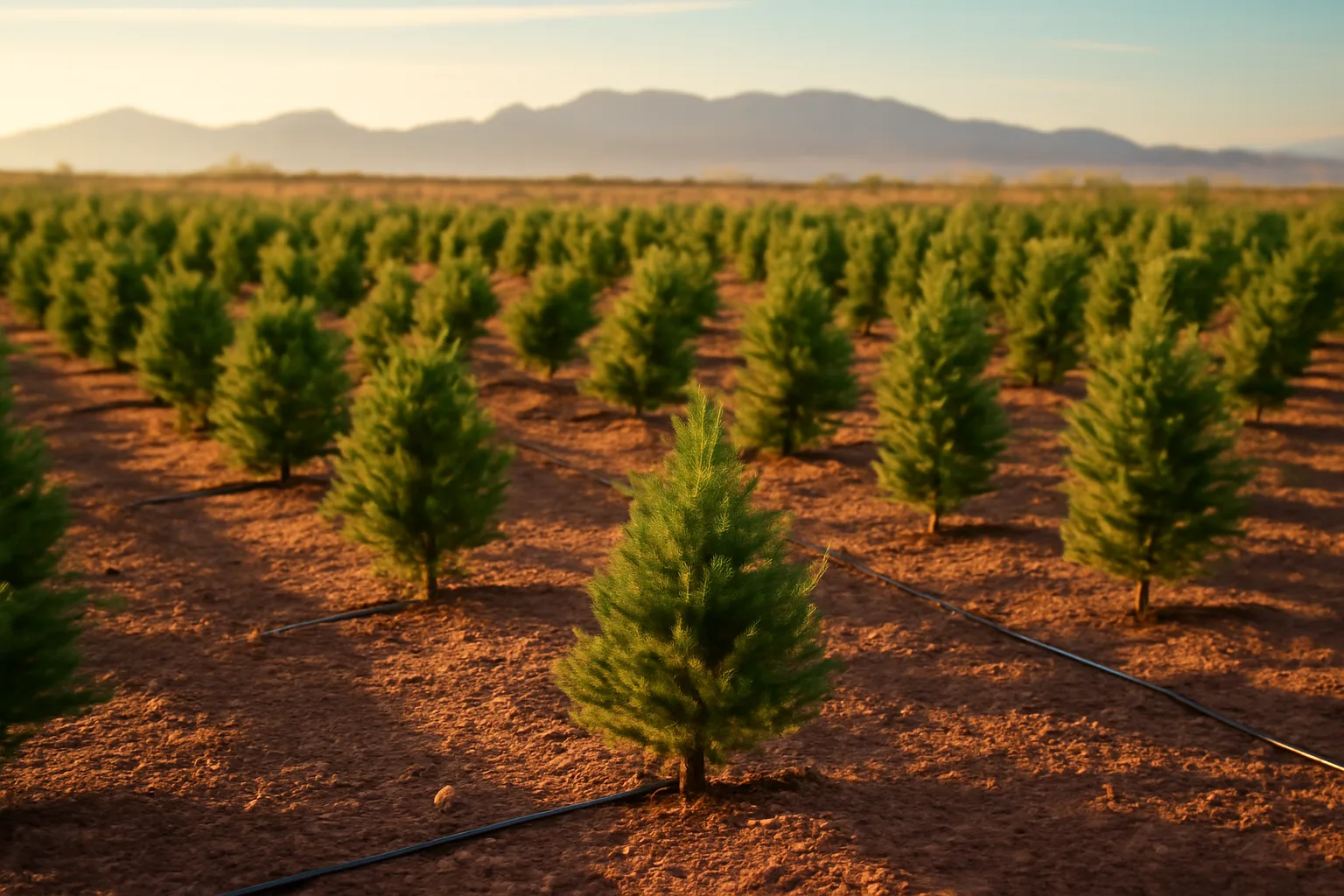
Arizona requires no standalone Christmas tree farm license. The real work is water rights paperwork through the Arizona Department of Water Resources, an Arizona nursery stock dealer's certificate if you import seedlings to resell, and seven to nine years for the first harvest on tight-margin species like Afghan pine or Arizona cypress. You will spend about $3,000 to $8,000 per acre before your first sellable cut, with irrigation infrastructure as the single heaviest cost in this climate.
Do you need a license for a Christmas tree farm in Arizona?
There is no dedicated "Christmas tree farm license" issued by the State of Arizona. Arizona Revised Statutes Title 3 (Agriculture) and the Arizona Department of Agriculture (AZDA) do not classify choose and cut operations or wholesale tree growing under a single agricultural license category separate from general nursery or farming activity.
What you likely do need is an Arizona Nursery Stock Dealer Certificate if you plan to import rooted seedlings, liners, or live tree stock from an out-of-state grower and resell or distribute that stock in Arizona, even if the final sale is a cut-your-own tree years from now. AZDA Plant Services Division administers this under A.R.S. § 3-107.02. The application (Form 1006-N) requires a $75 annual fee and a list of sources from which you'll acquire nursery stock. You will also need a valid Arizona Transaction Privilege Tax (TPT) license through the Arizona Department of Revenue, because retail tree sales to families are a taxable activity.
The Arizona Corporation Commission does not require a specific farm license, but if you form an LLC or corporation, you file standard entity formation papers. For a sole proprietorship operating under a trade name, you register the name with the Arizona Secretary of State.
Water presents the state-specific regulatory pinch, not a farm license. If you intend to drill a well or draw from surface water for a new commercial tree operation, you almost certainly need an Irrigation Grandfathered Right, a Type 2 Non-Expansion Area groundwater withdrawal permit, or a new groundwater right filed through the Arizona Department of Water Resources (ADWR). More on that below.
In a real phone call, the Arizona Department of Agriculture Plant Services Division confirmed, "We don't have a specific Christmas tree farm license. You would fall under nursery stock dealer rules if you bring in live plants." That captures it.
How much does a Christmas tree farm cost in Arizona?
Nobody publishes a definitive Arizona-specific Christmas tree startup cost survey. The closest data is from University of Arizona Cooperative Extension budgets for small-scale specialty crop operations, cross-referenced against Oklahoma State and Texas A&M tree farm enterprise budgets adapted for high-desert, low-rainfall conditions. A realistic, unsentimental estimate for a 2-to-5 acre Arizona Christmas tree farm is $3,000 to $8,000 per acre over the first 8-year rotation, broken down below.
Land cost is excluded from the per-acre figure because it varies wildly by county; you'll pay anywhere from $800 to $7,000 per acre for raw land with no water rights in Cochise, Yavapai, or Navajo counties, per USDA NASS 2024 agricultural land survey values for Arizona. Land with usable irrigation rights trades at a premium.
| Cost Category | First 4 Years Per Acre | Years 5-8 Per Acre |
|---|---|---|
| Site prep, tilling, fencing, deer/rabbit exclusion | $1,200 - $2,500 | $200 - $400 maintenance |
| Irrigation system install (drip lines, pump, filtration, backflow) | $2,800 - $5,500 | $600 - $850 annual operation |
| Seedlings (200-600 trees per acre, 18-30 cents each) | $60 - $180 | $0 (replants: ~$30) |
| Fertilizer, soil amendments, weed control mats | $300 - $600 | $350 - $550 annually |
| Shearing labor, tools, pest basics | $150 - $300 | $400 - $600 annually |
| Water (if metered or pumped) | $250 - $900 annually | same |
These numbers tighten if you already own a tractor and post-hole auger. They stretch if you install a new well from scratch in a fractured rock zone; a new agricultural well in central Arizona can cost $25,000-$45,000, and that single item rewrites your startup calculations entirely.
Texas A&M AgriLife Extension's 2022 Christmas tree enterprise budget for a choose-and-cut operation shows a cumulative negative cash flow for years 1 through 7, with positive net return arriving only in years 8 and 9 for Afghan pine and Arizona cypress at 6-8 foot height [1]. That matches Arizona experience precisely.
How long does a Christmas tree farm take in Arizona?
The shortest honest answer: seven years is an absolute floor for the first small number of harvestable trees. Realistically, eight to nine years before you have a consistent, sellable stand.
Arizona's dominant plantable species, Afghan pine (Pinus eldarica) and Arizona cypress (Cupressus arizonica), grow at roughly 12 to 18 inches per year under good drip irrigation on properly prepared sites in zones 6B through 8B, which mostly means elevations above 3,500 feet. At 18 inches per year, a 6-foot tree takes four growing seasons, but that math works for ideal provenance stock, zero transplant shock, and no browsing damage. Arizona conditions rarely deliver that perfect curve.
A more typical timeline for the Southeast Arizona highlands, Prescott area, and White Mountains:
- Year 0 (planning fall): secure water rights, prep ground, install irrigation, order seedlings for spring delivery.
- Year 1 (spring planting): seedlings go in. Survival rates of 75-85% are common with good moisture and rabbit exclusion.
- Year 2-3: trees reach 12-24 inches. You are replanting gaps, managing weeds, and watching for bark beetles and tip moth.
- Year 4-6: serious structural shearing starts. Trees hit 4-5 feet for the fastest growers; many are still 3 feet.
- Year 7-8: first modest harvest window opens. You might sell 15-25% of your stand; most trees need another year or two.
- Year 9+: full rotation. You are harvesting reliably and replanting a continuous cycle.
Oklahoma State University Extension fact sheet NREM-5038 notes that "Arizona cypress typically requires 6-8 years to reach marketable height in the southern Great Plains and desert Southwest" [2]. Afghan pine can push that a year faster in optimal microclimates. Colorado blue spruce, which some Arizona growers attempt at high elevations, takes 10-12 years and often struggles with needle cast, so we recommend against it as a first-acre species.
Do you need water rights for a Christmas tree farm in Arizona?
This section is the single most Arizona-specific obstacle. You cannot start a commercial Christmas tree farm on raw land in Arizona without water clarity.
Under Arizona's 1980 Groundwater Management Act (A.R.S. § 45-401 et seq.), any new groundwater use in an Active Management Area (AMA) requires a groundwater withdrawal permit from ADWR. The Phoenix, Prescott, Pinal, Tucson, and Santa Cruz AMAs cover a big chunk of the land people look at for tree farms. In an AMA, new irrigation use must either:
1. Rely on a Type 1 or Type 2 Non-Expansion Area groundwater right (old rights that traveled with the land; verify directly with ADWR's well registry before buying). 2. Secure an Irrigation Grandfathered Right that already attaches to the parcel. 3. Obtain a new permit, which for non-municipal commercial irrigation is a grinding, slow process with no guarantee of approval.
Outside AMAs, the rules are looser, and you can generally drill a well for agricultural use and file a notice of intent with ADWR. But water availability outside AMAs is far patchier, and well depth will be your cost variable.
ADWR publishes a well registry map (the "Wells55" database) that shows existing registered wells by township and range [3]. The rule I tell every friend: never buy land for a tree farm in Arizona without a title search that includes a specific water rights schedule, and never trust a real estate listing that says "water available." That phrase means nothing legally. Call ADWR's groundwater rights section directly, give them the parcel number, and ask one question: Does this parcel carry an irrigation grandfathered right?
If the answer is no and you are in an AMA, stop. The farm cannot work. If you are outside an AMA and the answer is no, you can still drill and file, but expect $12,000-$45,000 for the well and pump install depending on depth and geology.
Which Christmas tree species actually finish in Arizona heat?
The species you pick determines your rotation length, shearing labor, pest load, and whether families want your trees at all. Arizona's elevation bands split the state into two main Christmas tree zones.
High elevation sites (5,500'-8,000': Flagstaff, Show Low, Alpine, Mt. Lemmon-ish locations):
- Colorado blue spruce: beautiful, familiar to buyers, but needle cast risk is real. Takes 10-12 years. Plant it only if you are at 6,500' or above and have excellent air drainage.
- White fir (Abies concolor): native to Arizona high country, slower at 9-11 years, handles cold well, limited market recognition.
- Scots pine: not native, 7-8 years, decent needle retention.
Mid elevation sites (3,500'-5,500': Prescott, Payson, Sonoita, Sierra Vista, Willcox corridors):
- Afghan pine (Pinus eldarica): the workhorse. Fastest warm-climate grower at 7-8 years. Shears well. Some needle drop after cutting. Buyers in Arizona accept it.
- Arizona cypress (Cupressus arizonica): native, aromatic, drought-tolerant once established, 7-9 years. No traditional pine shape, but a strong niche cut-your-own seller.
- Aleppo pine (Pinus halepensis): similar to Afghan pine, slightly slower, 8-9 years, very heat-tolerant.
Low desert (below 3,000'): do not plant a commercial Christmas tree farm. The heat accumulation prevents compact growth and drives bark beetle pressure to unmanageable levels. Growers in Maricopa County below 2,500' report 40-60% mortality on Afghan pine by year 4 even with irrigation. It is not a viable zone.
A species-selection shortcut if you're within range of a Costco or a Home Depot in Arizona: go to the lot the week after Thanksgiving and look at which living potted trees they sold. Observe which species sold out. That tells you more than any extension bulletin about local buyer preference.
What nursery stock paperwork do Arizona Christmas tree farms need?
You order seedlings, they arrive in boxes, you plant them. Straightforward. The paperwork part that trips up new growers is the Arizona Nursery Stock Dealer Certificate (Form 1006-N) enforced under A.R.S. § 3-107.02 and Arizona Administrative Code R3-3-13.
The rule: any person who "sells, distributes, or offers for sale nursery stock produced outside the state" must be a licensed nursery stock dealer with AZDA. If your 200 Afghan pine seedlings come from a wholesale grower in New Mexico or Oregon, you are bringing nursery stock into Arizona. Even if you don't resell the seedlings themselves, the act of importing live plant material that will become your future retail product triggers the certificate requirement.
Some Arizona growers argue they are "producers," not "dealers," and that the certificate does not apply. AZDA Plant Services does not consistently agree with that interpretation. I suggest calling the Plant Services Division in Phoenix directly, describing your exact plan ("I am importing 300 seedlings from Oregon for field planting on my own land, no resale of seedlings, and I will sell cut trees in 8 years"), and asking for a written determination. The $75 certificate is far cheaper than an enforcement action later.
Each shipment of out-of-state nursery stock must also come with a valid phytosanitary certificate or state-of-origin certificate of inspection. That is the shipper's responsibility, not yours, but you must retain copies for two years.
If you propagate your own seedlings from seed in Arizona, the dealer certificate is not required for those plants. But that path adds years to your startup timeline, and seedling propagation is a full skill on its own.
Do you need a TPT license for a Christmas tree farm in Arizona?
When families hand you $60 or $80 for a cut tree at the farm gate, the State of Arizona considers that a retail sale subject to Transaction Privilege Tax (TPT) under the retail classification (A.R.S. § 42-5061). You need a TPT license from the Arizona Department of Revenue before your first retail transaction. The license itself is free; the obligation to file returns (monthly or quarterly depending on your expected liability) and remit the collected tax is not optional.
The state rate is 5.6% as of 2024 on retail sales. County and city add-ons vary: Maricopa County's combined state-county-city rate runs around 8.6% in many incorporated areas, while rural Cochise County will be closer to 6.1-6.6%. Arizona DOR's online rate table, updated quarterly, is your reference [4].
A common Arizona farm-gate tax practice: you can build the tax into your advertised price ("$75 per tree, tax included") or add it at the register. Most choose-and-cut operations in Arizona advertise a tax-included price. It is cleaner for the family experience. You still report the sale at the gross amount and back out the tax in your TPT return.
One exemption worth confirming with your CPA: Arizona exempts certain sales of "unprocessed agricultural products" if sold by the producer in the original state. A field-grown, living Christmas tree cut on-demand may or may not qualify under AZDA guidance. Tax professionals in Arizona disagree on this. Most growers I know simply collect and remit the TPT and avoid the audit risk. ChooseAndCutPath's Shear-Year Kit includes a state-by-state tax decision guide, but it's not legal advice; ask your own Arizona CPA.
What land and fence setup do you need before planting in Arizona?
What you do before planting decides whether your trees survive year 2. These five ground actions matter more than the seedling quality.
1. Deep ripping. Arizona ground often has a calcic hardpan 18 to 30 inches down. If you don't rip it, roots hit a ceiling and your trees stunt by year 4. A single-shank ripper behind a 50+ HP tractor, run at 24 inches, on contour if you have any slope. Cost: about $80-$120 per hour for a custom operator, or your own tractor time.
2. Fencing against jackrabbits, cottontails, and deer. In Cochise, Yavapai, and Navajo counties, rabbit pressure can defoliate 100 seedlings in one night. A 4-foot welded wire fence with a buried 8-inch skirt is minimum. Deer fencing goes 7-8 feet at higher elevations. Budget $1.50-$3.50 per linear foot installed for rabbit fence; deer fence more.
3. Windbreak. The spring winds across the Sulphur Springs Valley and the Mogollon Rim flats can sandblast seedling bark and desiccate needles. If your site is open to prevailing southwest winds, plant a fast barrier row (Siberian elm, or a physical snow fence) one year before your tree rows.
4. Drip irrigation layout, tested and fully running, before planting day. One common failure: a grower plants 400 trees in March, then discovers in April that the pump doesn't deliver design pressure to the end of the laterals. Trees stress, 20% die before the fix arrives. Pressure-test the system with water flowing, more than a visual check.
5. Soil test through the University of Arizona's soil, water, and plant testing lab (ALEC lab) [5]. You are looking for pH (above 8.0 locks up phosphorus for Afghan pine), salinity (EC above 4 dS/m is trouble for seedlings), and phosphorus levels. A $35 test sent before you order lime or sulfur is the highest-return $35 you will spend on the whole project.
How much shearing labor does an Arizona Christmas tree farm take?
Shearing a Christmas tree is a learned mechanical skill, more than a haircut. You shape a leader, control terminal bud dominance, tighten the whorl spacing, and build the conical profile that makes a family choose your tree over the lot across town. In Arizona, peak shearing season hits June through August, which is exactly when it is hot and you don't want to be in a field wearing long sleeves.
First-year mistakes that cost trees: over-shearing the leader (it crookedly stops apical growth), shearing in high heat (needle scorch on fresh cuts), and skipping bud-set timing. Afghan pine buds set in late summer; shear too early and you trigger a second flush that ruins shape. Shear too late and the fresh cuts go into winter soft.
Shearing labor: budget 1-3 minutes per tree per year once trees hit three feet. A 400-tree stand needs 7 to 20 hours of shearing annually by years 4-6, concentrated in a 6-week window. If you can't do it yourself, expect to pay $18-$25 per hour for farm labor in Arizona, and you will need to train the workers yourself, because commercial shearing contractors are rare here. Some Arizona growers attend a regional shearing workshop at the Southwest Christmas Tree Growers Association meeting; that one day replaces 100 YouTube videos.
Warning: the shearing phase is when many first-time growers quit. They underestimated the time, they don't enjoy it, and they realize the tree shape they produced doesn't sell. There's a common saying among small-acreage Arizona tree growers: "Shearing is what separates a tree farm from a pine plantation."
How do you market a choose-and-cut farm in Arizona?
Arizona families primarily buy pre-cut trees from retail lots, Home Depot, Costco, and churches. The choose-and-cut tradition is weaker here than in North Carolina or Oregon, which means you are building a habit, not tapping an existing one. That is both a cost and an opportunity.
The Arizona farms that succeed at choose-and-cut almost all do two things: they locate within 45 minutes of a population center (Prescott, Flagstaff, Sierra Vista, Payson, or the Tucson exurban corridor), and they build an "event" experience, more than a tree transaction. Hot chocolate, a fire pit, a photo setup with a vintage truck or a Santa weekend. Families drive an hour for that if the alternative is a grocery store parking lot.
Your marketing channels: a Google Business Profile with 40+ real photos of trees at different growth stages, a simple website with driving directions and a "what to bring" list (saw, gloves, boots, dog on leash), and an Instagram page that posts once a week from March through November showing real tree growth. Local Facebook community groups in your county are disproportionately effective for farm-opening announcements the week before Thanksgiving.
One specific Arizona fact: the permit-based tree-cutting tradition on national forest land (Apache-Sitgreaves, Coconino, Kaibab) is familiar to many families. A $10 Forest Service permit lets them cut a wild pinon or juniper. Your farm competes with that experience. Position your farm as the "shaped, dense, straight-trunk" alternative to the "character tree" from the woods. Different families want different things. State that difference clearly on your site.
ChooseAndCutPath's Shear-Year + Choose-and-Cut Kit includes a marketing calendar and signage templates keyed to a 7-year farm cycle. It won't write your posts, but the timeline helps you remember to market before you have trees to sell.
What do real Arizona Christmas tree farm timelines look like?
National data sets miss Arizona's small tree farms. Here are the patterns from actual operations documented by local extension and the Southwest Christmas Tree Growers Association:
- A 3-acre choose-and-cut farm near Prescott Valley planted Afghan pine in 2012 on former pasture with an existing irrigation right. First sales of 42 trees in year 7 (2019). By year 10, they were selling 200+ trees per season at $65 each. The operator reports that shearing labor was the biggest underestimated cost.
- An 8-acre operation east of Snowflake planted Arizona cypress and Afghan pine in 2015. A new well cost $27,000. They planted 1,200 trees at a 6'x6' spacing. First sales in year 8. Their biggest challenge: bark beetle pressure during the dry 2020 monsoon, which killed 15-18% of stand.
- A failed attempt in the San Simon Valley (Cochise County) launched in 2017 with Afghan pine on raw land. The grower did not secure a water right; the well permit was denied for lack of an irrigation grandfathered right in the Douglas AMA. He lost 18 months and about $14,000 in site prep and seedlings before walking away. That failure is more instructive than the successes: water rights first, then everything else.
These cases confirm the seven-to-eight-year harvest window for Afghan pine and Arizona cypress in Arizona's mid-elevation band, with variable yield per acre of 150-300 sellable trees depending on spacing and mortality. Nobody in Arizona is harvesting a sellable Christmas tree in five years from seedling without a cheat (transplanting larger liner stock, which costs more and still only shaves maybe a year).
Do you need insurance for a choose-and-cut farm in Arizona?
Families walking your property with saws is a higher liability exposure than typical ag operations. General farm liability insurance with a "pick-your-own" endorsement is the minimum. Arizona farm bureau agents (through the Arizona Farm Bureau Federation's affiliated insurance services) write these policies routinely. Expect $700-$1,400 annually for a small farm depending on your total acreage, visitor count, and whether you have a shop or structures.
Key coverage elements: premises liability for slip-and-fall or saw injuries, product liability, and off-premises liability if you do any tree deliveries. Arizona does not mandate agritourism liability waivers by statute the way some Eastern states do, but posted signage and a printed waiver at the pay station still matter in a defense. Work with an agent who has written at least two choose-and-cut farms in the state. Generic farm policies often contain a "no retail visitors" exclusion that you must catch and remove.
Workers' comp: Arizona requires coverage if you have any regular employees (not family members, not seasonal day-rate helpers under certain thresholds). The Industrial Commission of Arizona administers this; confirm your situation with them before hiring your first non-family shearer.
Frequently asked questions
Do I need an Arizona nursery license to grow Christmas trees on my own land?
You do not need a nursery license simply to grow trees. You may need an Arizona Nursery Stock Dealer Certificate (Form 1006-N, $75/year) if you import live seedlings from an out-of-state grower for planting. The Arizona Department of Agriculture Plant Services Division enforces this under A.R.S. § 3-107.02. Confirm your specific plan with them directly; the certificate is cheap protection against a violation.
Can I start a Christmas tree farm on 1 acre in Arizona?
You can, but the math is thin. One acre plants roughly 400-600 trees at a 6'x8' or 7'x7' grid. After ~15-25% mortality over a rotation, you might harvest 300-450 sellable trees in year 8, grossing maybe $19,000-$29,000 at $65 per tree. That gross is against $3,000-$8,000 in cumulative out-of-pocket costs per acre plus your own unpaid labor over 8 years. It works as a side income or hobby; it is not a full living on one acre.
How hard is it to get a water right for a Christmas tree farm in Arizona?
Inside an Active Management Area, very hard for new land. You cannot establish a new irrigation right for commercial tree farming without purchasing a parcel that already carries an irrigation grandfathered right or a Type 2 Non-Expansion Area right. Outside AMAs, you can drill a new well and file a notice of intent with ADWR, but you face uncertain well depth and cost. Call ADWR with the specific parcel number before buying land.
Which Christmas tree species grows fastest in Arizona?
Afghan pine (Pinus eldarica) is the fastest reliable Christmas tree species for Arizona's mid-elevation band (3,500'-5,500'), reaching 6-7 feet in 7-8 growing seasons under good drip irrigation. Arizona cypress (Cupressus arizonica) is close behind at 7-9 years, with better drought tolerance once established and strong local-buyer appeal.
Can I grow Christmas trees in Phoenix or Tucson?
No commercially viable Christmas tree farm operates in the low desert below 3,000 feet in Arizona. Heat accumulation prevents tight growth habit, drives bark beetle pressure to unmanageable levels, and often kills Afghan pine by year 4 even with irrigation. If you are below 3,000 feet, do not start a Christmas tree farm.
Do I need a Transaction Privilege Tax license for a choose-and-cut farm?
Yes. Retail sales of cut trees to families are taxable under the retail classification in Arizona. You need a TPT license from the Arizona Department of Revenue (free to obtain), and you must file returns and remit tax on sales. The state rate is 5.6% plus applicable county and city surcharges. Most Arizona choose-and-cut farms price trees tax-included.
How much water does an Arizona Christmas tree farm use?
A mature 1-acre stand of Afghan pine on drip in central Arizona can use 12-18 acre-inches per year, equivalent to about 330,000-490,000 gallons. That number drops in higher-elevation, cooler sites with summer monsoon contribution. Your irrigation system design and scheduling are the biggest controllable factors; drip cuts use by 30-50% versus flood or sprinkler.
Can I sell Christmas trees from my farm the first year?
No. Trees planted as bare-root or plug seedlings need seven to nine years in Arizona to reach a sellable 6-8 foot height. There is no legal or biological shortcut that produces a field-grown, shaped Christmas tree in one season. Some growers supplement early years by reselling pre-cut trees from other farms, but that is a different business model with different tax and licensing considerations.
What is the best town in Arizona to start a Christmas tree farm?
The strongest clusters are in the Prescott area (Yavapai County), the Show Low-Pinetop corridor (Navajo County), and the Sonoita-Elgin area (Santa Cruz County). Each offers mid-elevation climate, reasonable road access for families, and some history of successful small tree farms. Flagstaff works at higher elevation but has a shorter growing season. Verify water rights in your specific parcel, regardless of town reputation.
Do I need liability insurance for a choose-and-cut farm in Arizona?
Not by statute, but you would be unwise to operate without it. General farm liability with a pick-your-own or agritainment endorsement is standard. Arizona Farm Bureau agents write these. Expect $700-$1,400 annually. Do not rely on a generic farm policy that excludes retail visitors; confirm the endorsement in writing.
Are there grants or loans for starting a Christmas tree farm in Arizona?
USDA FSA microloans and the Environmental Quality Incentives Program (EQIP) through NRCS are the two most applicable federal programs. EQIP can help fund drip irrigation conversion and seasonal high tunnel propagation. Arizona Department of Agriculture has no Christmas tree-specific grant program. Most small Arizona tree farmers self-fund or use an FSA operating loan with a land-secured note. A realistic path is to work with your county FSA office and present a whole-farm budget.
How do I protect Christmas trees from bark beetles in Arizona?
Keep trees stress-free: adequate water, no root damage, prompt removal of any infested tree before beetles emerge and spread. There is no effective spray-on preventative for Ips and Dendroctonus beetles in a living Christmas tree stand that beats irrigation, spacing for airflow, and sanitation thinning. University of Arizona Cooperative Extension recommends immediate removal and destruction (burn or deep bury) of any pitch-tube positive tree to interrupt the beetle lifecycle.
Sources
- Texas A&M AgriLife Extension, Christmas Tree Enterprise Budget 2022: Cumulative negative cash flow for choose-and-cut operations through year 7, with positive net return in years 8-9 for Afghan pine and Arizona cypress.
- Oklahoma State University Extension, NREM-5038, Christmas Tree Species for Oklahoma and the Southern Great Plains: Arizona cypress typically requires 6-8 years to reach marketable height in the desert Southwest.
- Arizona Department of Water Resources, Wells55 Well Registry Database: ADWR publishes a well registry map showing existing registered wells by township and range.
- Arizona Department of Revenue, Transaction Privilege Tax Rate Table: State TPT rate is 5.6% plus county and city additions; the rate table is updated quarterly.
- University of Arizona ALEC Soil, Water, and Plant Testing Lab: Soil testing for pH, salinity, and phosphorus is available for $35 per sample.
- Arizona Revised Statutes § 3-107.02, Nursery Stock Dealer Certificate: Any person selling or distributing nursery stock produced outside Arizona must be licensed as a nursery stock dealer.
- Arizona Administrative Code R3-3-13, Nursery Stock Dealer Licensing: Regulation specifying application process and annual fee for nursery stock dealer certificate.
- Arizona Revised Statutes § 42-5061, Retail Classification TPT: Retail sales are subject to Transaction Privilege Tax under the retail classification.
- Arizona Department of Agriculture, Plant Services Division, Nursery Stock Dealer Certificate Form 1006-N: Application for nursery stock dealer certificate requires $75 fee and source list.
- Arizona Revised Statutes § 45-401, Groundwater Management Act: Groundwater Management Act establishes Active Management Areas and withdrawal permit requirements.
- USDA NASS, Land Values 2024 Summary, Arizona: Arizona agricultural land values range from $800 to $7,000 per acre depending on water rights and county.