Last updated 2026-08-17
TL;DR
Alaska has no single "christmas tree farm license." You register a business with the state ($50/year), get a Nursery Dealer Certificate from the Division of Agriculture if you sell live stock or transplants, and secure a timber sale or special-use permit from the Alaska DNR or USFS if you harvest on public land. Private-land growers face the fewest hurdles. Budget 4-12 weeks for the full permit stack.
Do you need a license for a christmas tree farm in Alaska?
There is no dedicated "christmas tree farm license" in Alaska. The state does not issue one. What you actually need depends on three variables: who owns the land you're farming, whether you're selling live plant material or just cut trees, and whether you're hiring workers.
For most small private-land operations, the list is short. You register a business entity or assumed business name with the Alaska Division of Corporations [1], and if you sell live seedlings, transplants, or rooted cuttings alongside your cut trees, you pick up a Nursery Dealer Certificate from the Alaska Division of Agriculture [2]. That certificate runs a nominal annual fee (confirm the current amount directly with the Division of Agriculture, since the schedule gets revised).
If your trees are on state or federal land, the permit path is heavier. Harvesting Christmas trees from Alaska State land requires a timber sale contract or a personal-use timber permit from the Alaska Department of Natural Resources, Division of Forestry and Fire Protection [3]. Cutting from national forest land, including the Tongass or Chugach, requires a special-use permit or a commercial timber permit from the relevant U.S. Forest Service district [4]. The Tongass alone contains roughly 16.7 million acres, so most Southeast Alaska operations bump into federal paperwork whether they want to or not.
Here's the short version. Private land, cut trees only, no live plant sales means a business registration plus your local borough business license if your borough requires one. Add land access permits and a nursery certificate as your situation demands.
What licenses and permits do Alaska christmas tree farmers actually file?
Here is every document category worth knowing about, roughly in the order you'd file them.
Alaska business registration. Any for-profit operation doing business under a name other than your own personal legal name files a Business License with the Alaska Department of Commerce, Community, and Economic Development [5]. The annual fee is $50 for most businesses (confirm the current fee at filing). If you form an LLC or corporation, you also pay a biennial report fee. This step comes first because you need a business license number before some other agencies will talk to you.
Borough or city business license. Many Alaska boroughs, including the Matanuska-Susitna, Kenai Peninsula, and Fairbanks North Star boroughs, have their own local license or tax registration requirements. Confirm with your specific borough government. Some charge nothing. A few charge $25-$100 per year.
Alaska Nursery Dealer Certificate. The Alaska Division of Agriculture regulates the movement and sale of plants to prevent the spread of pests and disease [2]. If you sell any live plant material, including seedlings you grew or purchased for resale, you need this certificate. The annual fee is nominal (confirm the current amount directly with the Division of Agriculture before filing).
State timber permit (state land only). The Alaska DNR Division of Forestry offers personal-use timber cutting permits for small volumes. Commercial harvest of timber on state land requires a competitive timber sale process or a negotiated contract [3]. Growing trees on state land under a lease is a separate track entirely and involves an Agricultural Land application or a Remote Recreational Cabin Permit process depending on intended use.
Federal special-use permit (national forest land only). If any part of your operation, including access roads, staging areas, or actual tree harvest, falls on Tongass or Chugach National Forest land, you need a permit from the USFS. The agency's Special Uses program covers commercial Christmas tree sales [4]. Contact the specific ranger district for current fees and application windows, since these vary by district and are not posted uniformly online.
Pesticide applicator license. If you spray any pesticide on your trees, including herbicides used in plantation establishment, you need a Commercial Pesticide Applicator License from the Alaska Division of Agriculture [6]. This requires passing a written exam. Private-applicator certificates cover farm owners applying only to their own land and have a lower bar, but you still have to certify.
How much does a christmas tree farm cost in Alaska?
This question has two very different answers: the cost of the licenses and permits, and the cost of actually getting a farm running. Both matter.
Permit and license cost stack (annual, approximate):
| Document | Issuing body | Approximate cost |
|---|---|---|
| Alaska Business License | DCCED [5] | $50/year |
| Borough business license | Your borough | $0-$100/year |
| Nursery Dealer Certificate | Div. of Agriculture [2] | Nominal annual fee |
| Pesticide applicator cert. | Div. of Agriculture [6] | ~$75 exam + cert |
| State timber permit (if applicable) | DNR Forestry [3] | Varies by volume |
| Federal special-use permit (if applicable) | USFS [4] | Varies by district |
Total annual government paperwork cost for a private-land, cut-tree-only operation with no live sales runs roughly $50-$150. Add the nursery and pesticide credentials and you're probably at $200-$350 in year one, then lower after that.
Startup and land costs are the real numbers. Land in Alaska suited to Christmas tree production, mostly the Matanuska-Susitna Valley, which has the most agricultural history in the state, runs a wide range. The USDA's most recent Alaska agricultural census shows average farmland values well below the Lower 48 average, but suitable parcels with road access in the Mat-Su can still run $2,000-$8,000 per acre depending on location and improvements [7]. You can lease state agricultural land for a lot less, but that path runs through the DNR agricultural land program and a separate application.
Tree seedling costs for Sitka spruce, white spruce, or Scots pine transplants run roughly $0.40-$1.50 per seedling in bulk depending on species and age class (confirm current pricing with Alaska-permitted nursery suppliers or the DNR forestry assistance program). A one-acre planting at 1,000-1,500 trees per acre means $400-$2,250 in seedling cost alone, before site prep, fencing against moose, and labor.
Moose browse is a real and under-discussed cost in Alaska. Unprotected seedling plantings in moose country can lose 30-60% of stock in the first two winters without tubing or fencing. That protection adds $0.50-$2.00 per tree depending on method. Nobody has precise Alaska-specific loss data I've found in a published study. The range above comes from extension guidance and USDA Forest Service planting notes for the region [8].
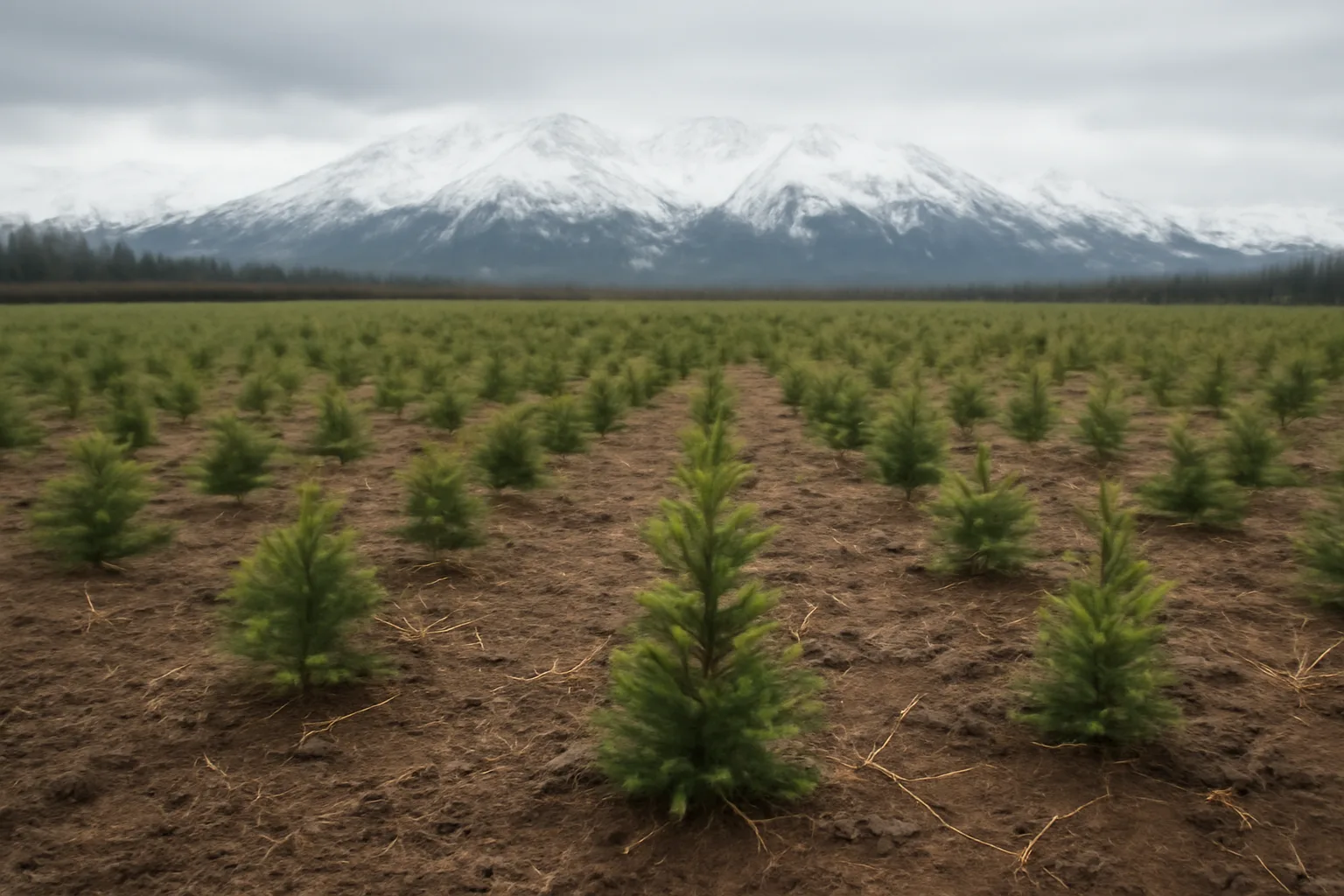
Nobody should start a Christmas tree farm in Alaska thinking they'll clear land this spring and sell trees in three years. Spruce species suited to Alaska's climate take 8-12 years from seedling to a marketable 6-foot tree under normal conditions. Budget accordingly.
How long does a christmas tree farm take in Alaska?
Two timelines matter here: how long to get your permits, and how long before you sell a single tree.
Permit timeline. The Alaska Business License typically processes in 2-5 business days if filed online through the DCCED portal [5]. The Nursery Dealer Certificate from the Division of Agriculture generally takes 2-4 weeks depending on workload and whether an inspection is needed. A pesticide applicator certification requires scheduling and passing an exam. Plan 4-8 weeks from start to certificate in hand. Borough licenses vary widely. Total realistic timeline from first filing to full compliance runs 4-12 weeks.
Federal special-use permits from the USFS are a different story. Environmental reviews, district workloads, and sometimes NEPA-level analysis can stretch federal permit timelines to 6-18 months for anything beyond a simple personal-use cutting authorization. Do not underestimate this if any of your operation touches national forest land.
Tree-growing timeline. This is the hard number that kills most over-optimistic business plans. Sitka spruce, the Alaska native species most growers look at first because of its beauty and regional identity, grows slowly. Expect 10-14 years from planting a 1-2 year transplant to a marketable 5-7 foot tree in Southcentral Alaska, where the growing season runs roughly 100-130 frost-free days [8]. White spruce is similar. Some growers in the Mat-Su report pulling trees at 9-10 years under good soil and fertility management, but 12 years is a safer planning number.
The University of Alaska Fairbanks Cooperative Extension Service has noted that short growing seasons and permafrost proximity are the two variables that most affect establishment success in the state [8]. Site selection above permafrost and with good drainage cuts years off that timeline.
There is no shortcut. If you want to open a choose-and-cut operation and you're starting with bare land and seedlings today, your realistic first sales season is roughly 2036-2038.
What land ownership situation do Alaska christmas tree farmers typically face?
Alaska's land ownership pattern is unlike any other state. The federal government owns roughly 61% of Alaska's land, the state owns about 28%, and private and Native corporations own the rest [9]. That means a very large share of potentially farmable or timber-productive land is not privately owned, and accessing it adds permit layers that simply don't exist in states like Oregon or Michigan where Christmas tree farming is dominated by private landowners.
Private agricultural land in Alaska is concentrated in three areas: the Matanuska-Susitna Valley, the Tanana Valley around Fairbanks, and the Kenai Peninsula. The Mat-Su Valley is by far the most established agricultural area and the most realistic starting point for someone new to Alaska christmas tree farming.
State land is available for agricultural leases through the DNR's Division of Mining, Land and Water. The process involves applying, competing in some cases, and demonstrating a viable agricultural development plan. This is not fast. The DNR's agricultural land program is real and does issue leases, but expect a multi-year process from application to operation for anything beyond a small parcel [3].
Native corporation land is a third option in some regions, but access requires direct negotiation with the relevant corporation (CIRI, Sealaska, Doyon, and others), and terms vary completely from deal to deal. There is no standard public process for this track.
If you're looking at a ready-to-go setup for your first years in the industry, the how to start a christmas tree farm in Alaska guide covers site selection, species choice, and the land access options in more detail.
What are Alaska's rules for selling christmas trees to the public?
Alaska does not have a Christmas tree-specific retail sales license. The standard Alaska Business License covers retail sales of agricultural products including trees.
If you're selling from your farm as a choose-and-cut operation, you are running a retail agricultural business. The sales tax question depends on your borough. Some Alaska boroughs have no sales tax. Others, like the Kenai Peninsula Borough, do. Confirm your borough's tax rules before you set prices.
If you transport trees across state lines (say, you sell to buyers in Washington or ship trees produced elsewhere in Alaska for resale), you may need a phytosanitary certificate from the Alaska Division of Agriculture confirming your trees are free of regulated pests. This is mostly relevant for commercial wholesale operations, not small choose-and-cut farms.
For roadside or off-farm lot sales, check whether your local municipality requires a temporary merchant permit or a specific zoning clearance for seasonal outdoor retail. The Municipality of Anchorage, for example, has its own licensing overlay that the state business license does not replace.
Checking comparable state processes can also help you anticipate what Alaska may ask for down the road. The christmas tree farm license in Arizona guide and the christmas tree farm license in Colorado guide both show how western states with significant public land handle the grower-to-retail step, and Alaska's approach rhymes with those more than it does with southeastern states.
Are there federal permits Alaska christmas tree farmers need to know about?
Yes, and this section is the one most Alaska-specific guides get wrong by leaving it out.
The USDA Forest Service issues permits for commercial Christmas tree harvesting and sales operations on national forest land. In Alaska, this mostly means the Tongass National Forest (Southeast Alaska) and the Chugach National Forest (Southcentral Alaska). The Tongass is the largest national forest in the United States at 16.7 million acres [4].
The USFS also runs a program for non-commercial personal-use Christmas tree cutting on national forest land. In past years, the Chugach National Forest has sold individual personal-use cutting permits for around $5 per tree for personal holiday use. These are not commercial farming permits and do not authorize you to grow, replant, or operate a business on national forest land.
Commercial tree farming on national forest land requires a Special Use Permit under 36 CFR Part 251. The regulation states that "all uses of National Forest System lands, improvements, and resources, except those authorized by the regulations governing sharing use of roads... are designated 'special uses'" and require authorization [4]. The process involves an application, often an environmental review, and annual or multi-year permit terms with fees set by the district.
The USDA's Natural Resources Conservation Service (NRCS) also runs programs relevant to Alaska christmas tree farmers, including the Environmental Quality Incentives Program (EQIP), which can partially fund practices like windbreaks, irrigation systems, and soil conservation work on agricultural operations [10]. Alaska-specific EQIP payment rates and practice eligibility are published annually by the Alaska NRCS state office.
For anyone dealing with the federal permit stack and wanting a structured checklist of what to pull together, the paper kit at ChooseAndCutPath's /start page covers the federal and state document sequence in a single reference.
What species do Alaska christmas tree farms grow?
Species choice in Alaska is constrained by climate and market in ways that don't apply in Oregon or North Carolina.
White spruce (Picea glauca) is the most common commercial Christmas tree species in Alaska because it's native, cold-hardy across most of the state's farmable zones, and accepted by buyers who want an "Alaska-grown" product. It grows slowly, as noted above, but it's reliable.
Sitka spruce (Picea sitchensis) is native to coastal and Southeast Alaska and has excellent form for Christmas trees, but it performs poorly in interior Alaska climates. If your farm is in Southeast, Sitka spruce is worth serious consideration.
Scots pine (Pinus sylvestris) has been tried by some Alaska growers and does reasonably well in Southcentral, but it is a non-native species. Some buyers and choose-and-cut customers specifically want native spruce, so do your market research before you plant 5,000 Scots pine.
Nobody grows Fraser fir commercially in Alaska. The climate is wrong. If you see a Fraser fir at an Alaska lot, it was shipped up from the Pacific Northwest or the Southeast.
The University of Alaska Fairbanks Cooperative Extension Service has published species and variety guidance for Alaska agricultural producers [8]. That's the right primary source for updated recommendations, since climate and variety testing data do change.
How does Alaska's tax treatment affect christmas tree farm economics?
Alaska has no state income tax and no state sales tax. Those two facts meaningfully change the economics of a small agricultural business compared to most other states.
There is no state-level sales tax on Christmas trees in Alaska. Borough-level sales taxes apply in some areas, but not all. The Matanuska-Susitna Borough, for example, has no sales tax as of the most recent published information (confirm current status with the borough, since this can change).
Farm income is still subject to federal income tax. The IRS allows Christmas tree farms to use several agricultural accounting methods. Trees grown for sale as Christmas trees are explicitly included in the definition of "farming" under IRC Section 263A(e)(4), and small producers may be exempt from the uniform capitalization rules that complicate accounting for larger tree farms. Talk to a CPA familiar with agricultural operations before your first tax year. The accounting elections you make early matter.
Property tax treatment of agricultural land varies by borough. Some Alaska boroughs offer preferential assessment for agricultural land in active production. This is worth confirming with your borough assessor before you buy or lease, because the difference between agricultural and standard residential or commercial assessment can be substantial on larger parcels.
Alaska also has a Permanent Fund Dividend program, which is individual income, not business-related. It does not interact with farm licensing or taxation in any direct way.
What should Alaska christmas tree farmers do in year one?
Year one is almost all planning and paperwork, which sounds boring but is the difference between a farm that survives and one that gets shut down or loses its seedling investment to moose.
Start with land confirmation. Whether you own, lease, or are negotiating access, know your legal status before you spend a dollar on seedlings. If any portion of your planned acreage is on state or federal land, begin the permit application immediately because those timelines are long.
File your Alaska Business License online through the DCCED portal [5]. It's a same-week task. If your borough requires a local license, file that at the same time.
Contact the Alaska Division of Agriculture about the Nursery Dealer Certificate [2] even if you're not sure you'll sell live stock. The application is simple, and having it means you can adapt your business model without a delay later.
Get your soil tested. The University of Alaska Cooperative Extension Service offers soil testing guidance, and knowing your pH and nutrient levels before planting determines whether your site is viable and what amendments you need [8]. Spruce generally prefers pH 5.0-6.0. Many Alaska soils sit in that range naturally, but don't guess.
Order seedlings early. Alaska-permitted nurseries and the DNR's Ketchikan Nursery (which produces native tree species for reforestation) have limited stock, and orders for spring planting fill up. If you wait until March to order, you may not get seedlings that year [3].
Plan for moose protection from day one. It is not optional in most of Alaska. Tube shelters, wire cages, or perimeter fencing: pick your method and budget it before you plant.
If you want a single document that sequences all of this in one place, the how to start a christmas tree farm in Alaska guide covers the operational path alongside the licensing path.
How does Alaska compare to other states for christmas tree farm licensing burden?
Alaska's private-land licensing burden is actually lighter than many states. There is no dedicated nursery production license for tree farms that don't sell live stock, no mandatory state inspection program for cut-tree operations, and no state sales tax layer.
States like California have a more complex nursery licensing regime with tiered fees based on acreage and sales volume, plus county-level permits that add cost and time. The christmas tree farm license in California guide documents that stack if you want a comparison. Colorado is closer to Alaska in its overall approach but has a dedicated nursery grower registration that Alaska does not require for cut-tree-only farms. See the christmas tree farm license in Colorado guide for that state's specifics.
Where Alaska is harder than most states is the land access layer. No other state has the combination of 61% federal land, significant state land, and Native corporation land creating overlapping jurisdictions. A farmer in Alabama or Arkansas almost certainly owns their land outright and has no federal land permit to worry about. The christmas tree farm license in Alabama guide shows how much simpler that paper path is.
The table below summarizes how Alaska's estimated annual permit costs compare to a few comparable states for a private-land, cut-tree-only operation.
| State | Approx. annual license/permit cost (private land, cut trees only) | Nursery registration required? |
|---|---|---|
| Alaska | $50-$150 | Only if selling live stock |
| Colorado | $75-$200 | Yes, nursery grower registration |
| California | $100-$400+ | Yes, tiered by sales volume |
| Alabama | $50-$100 | Only for live stock sales |
| Arkansas | $50-$125 | Only for live stock sales |
Sources: respective state agricultural department fee schedules. Confirm current fees with each state agency before filing.
Frequently asked questions
Do you need a license for a christmas tree farm in Alaska?
There is no dedicated christmas tree farm license in Alaska. You need an Alaska Business License ($50/year) from the Division of Corporations, and a Nursery Dealer Certificate from the Division of Agriculture if you sell live plant material. If you're harvesting trees from state or federal land, you'll also need a timber permit or USFS special-use permit. Private-land, cut-tree-only operations have the shortest list.
How much does it cost to start a christmas tree farm in Alaska?
Government paperwork for a private-land, cut-tree-only operation runs roughly $50-$350 in year one depending on which permits apply. Land, site prep, seedlings, and moose protection are the real costs. Suitable land in the Matanuska-Susitna Valley can run $2,000-$8,000 per acre. Seedlings cost $0.40-$1.50 each in bulk. A one-acre planting with moose protection can easily top $3,000 before you touch a single tree.
How long does it take to grow christmas trees in Alaska?
White spruce and Sitka spruce, the two most common commercial species in Alaska, take 10-14 years from a 1-2 year transplant to a marketable 5-7 foot tree in Southcentral Alaska. Growing seasons run roughly 100-130 frost-free days depending on location. Site selection with good drainage and soil above permafrost can improve those numbers, but anyone projecting sales in under 9 years from planting is being optimistic.
How long does it take to get an Alaska Business License?
The Alaska Department of Commerce, Community, and Economic Development typically processes Business License applications in 2-5 business days when filed online. Paper applications take longer. The license is annual and must be renewed each year. Your specific borough may require an additional local license, and processing times for those vary, so check directly with your borough.
Do I need a nursery license to sell christmas trees in Alaska?
Not if you're only selling cut trees you grew yourself with no live plant material. The Nursery Dealer Certificate from the Alaska Division of Agriculture is required when you sell live plants, seedlings, transplants, or rooted cuttings. If your choose-and-cut farm also sells potted live trees or starter seedlings as an add-on, that triggers the nursery certification requirement. Confirm the current fee directly with the Division.
Can I grow christmas trees on Alaska state land?
Yes, but it requires going through the Alaska DNR's Division of Mining, Land and Water for an agricultural land lease or a timber-related authorization. The process involves an application, a development plan, and in some cases a competitive process. It is not a fast path. Personal-use timber permits from DNR Forestry cover small-volume cutting for personal use, not commercial farm establishment. Contact the DNR regional forestry office for the current application process.
Do I need a federal permit to sell christmas trees in Alaska?
If your farm is entirely on private land, no federal permit is needed for sales. A federal USFS Special Use Permit is required for any commercial activity on Tongass or Chugach National Forest land, including harvesting, staging, or operating a sales lot on national forest property. Personal-use Christmas tree cutting permits (around $5 per tree in recent years) are separate and don't authorize commercial operations.
What is the best location in Alaska for a christmas tree farm?
The Matanuska-Susitna Valley is the most established agricultural region in Alaska and the most practical starting point. It has road access to Anchorage (Alaska's main market), established agricultural infrastructure, and soils suited to spruce production. The Kenai Peninsula is a secondary option. Interior Alaska near Fairbanks is viable for hardy species but market access is harder and the climate is more extreme. Southeast Alaska has climate advantages for Sitka spruce but land access is complicated by federal ownership.
Do Alaska christmas tree farms need a pesticide applicator license?
Yes, if you apply pesticides including herbicides. A Commercial Pesticide Applicator License from the Alaska Division of Agriculture requires passing a written exam. A Private Applicator Certificate has a lower bar and covers farm owners applying pesticides only to their own land. If you use a licensed pesticide application service, you don't need your own certification. Confirm current exam scheduling and fees with the Division of Agriculture before your first growing season.
Is there an Alaska sales tax on christmas trees?
Alaska has no state sales tax, so there is no state-level tax on Christmas tree sales. Some boroughs have local sales taxes. The Matanuska-Susitna Borough currently has no sales tax, but the Kenai Peninsula Borough does. Confirm your specific borough's tax rules before setting prices. Christmas trees are generally not separately exempted from local taxes where those taxes exist, so the borough rate applies to your sales.
What species of christmas trees grow best in Alaska?
White spruce is the most reliable commercial species across most of Alaska's farmable zones. Sitka spruce works well in coastal and Southeast Alaska. Scots pine has been grown successfully in Southcentral Alaska but is non-native and some buyers prefer native species. Fraser fir does not grow commercially in Alaska's climate. The University of Alaska Fairbanks Cooperative Extension Service publishes updated species guidance for Alaska agricultural producers and is the right source for current variety recommendations.
Can I harvest christmas trees from the Tongass National Forest?
Personal-use cutting (not commercial) is allowed with a low-cost personal-use permit from the USFS Tongass district. Commercial Christmas tree operations on Tongass land require a Special Use Permit under 36 CFR Part 251. Contact the specific ranger district where you want to operate, since application processes, fees, and availability vary by district. Commercial permits involve an application review and sometimes an environmental review, so start early.
How do I protect christmas tree seedlings from moose in Alaska?
Moose browse is one of the most significant first-year risks for Alaska christmas tree farms. Common protection methods include individual tree tubes (plastic shelters that also help with microclimate), wire cages around individual trees, or perimeter fencing of the entire planting block. Costs run $0.50-$2.00 per tree for individual protection or more for perimeter fencing depending on acreage. Unprotected seedlings in moose country can lose 30-60% of stock in the first two winters.
Are there USDA grants or cost-share programs for Alaska christmas tree farmers?
Yes. The NRCS Environmental Quality Incentives Program (EQIP) provides cost-share payments for eligible conservation practices on agricultural operations, including windbreaks, soil health practices, and irrigation. Alaska EQIP payment schedules and eligible practices are published annually by the Alaska NRCS state office. The USDA Farm Service Agency also has programs relevant to new farm operations. Contact your local NRCS field office early in your planning process, since application windows are seasonal.
Sources
- Alaska Division of Corporations, Business and Professional Licensing - Business Licensing: Alaska Business License is issued by the Division of Corporations, Business and Professional Licensing; annual fee is $50 for most businesses
- Alaska Division of Agriculture - Plant Materials Center: Alaska Nursery Dealer Certificate is required for sale of live plant material including seedlings and transplants; issued by the Division of Agriculture
- Alaska Department of Natural Resources, Division of Forestry and Fire Protection: Commercial harvest of timber on Alaska state land requires a timber sale contract or permit from the DNR Division of Forestry; personal-use permits also available for small volumes
- USDA Forest Service - Tongass National Forest: Commercial operations on Tongass National Forest land require a Special Use Permit under 36 CFR Part 251; the Tongass covers approximately 16.7 million acres
- Alaska Department of Commerce, Community, and Economic Development - Business Licensing: Alaska Business License can be filed online through the DCCED portal and typically processes in 2-5 business days
- USDA National Agricultural Statistics Service - 2022 Census of Agriculture, Alaska State Profile: USDA 2022 agricultural census data on Alaska farmland values and agricultural land characteristics
- University of Alaska Fairbanks Cooperative Extension Service - Agriculture and Horticulture: Alaska's growing season runs approximately 100-130 frost-free days in Southcentral; short seasons and permafrost proximity affect establishment success; spruce species guidance for agricultural producers
- Congressional Research Service - Federal Land Ownership: Overview and Data (R42346): Federal government owns approximately 61% of Alaska land; state owns approximately 28%; private and Native corporation land comprises the remainder