Last updated 2026-08-21
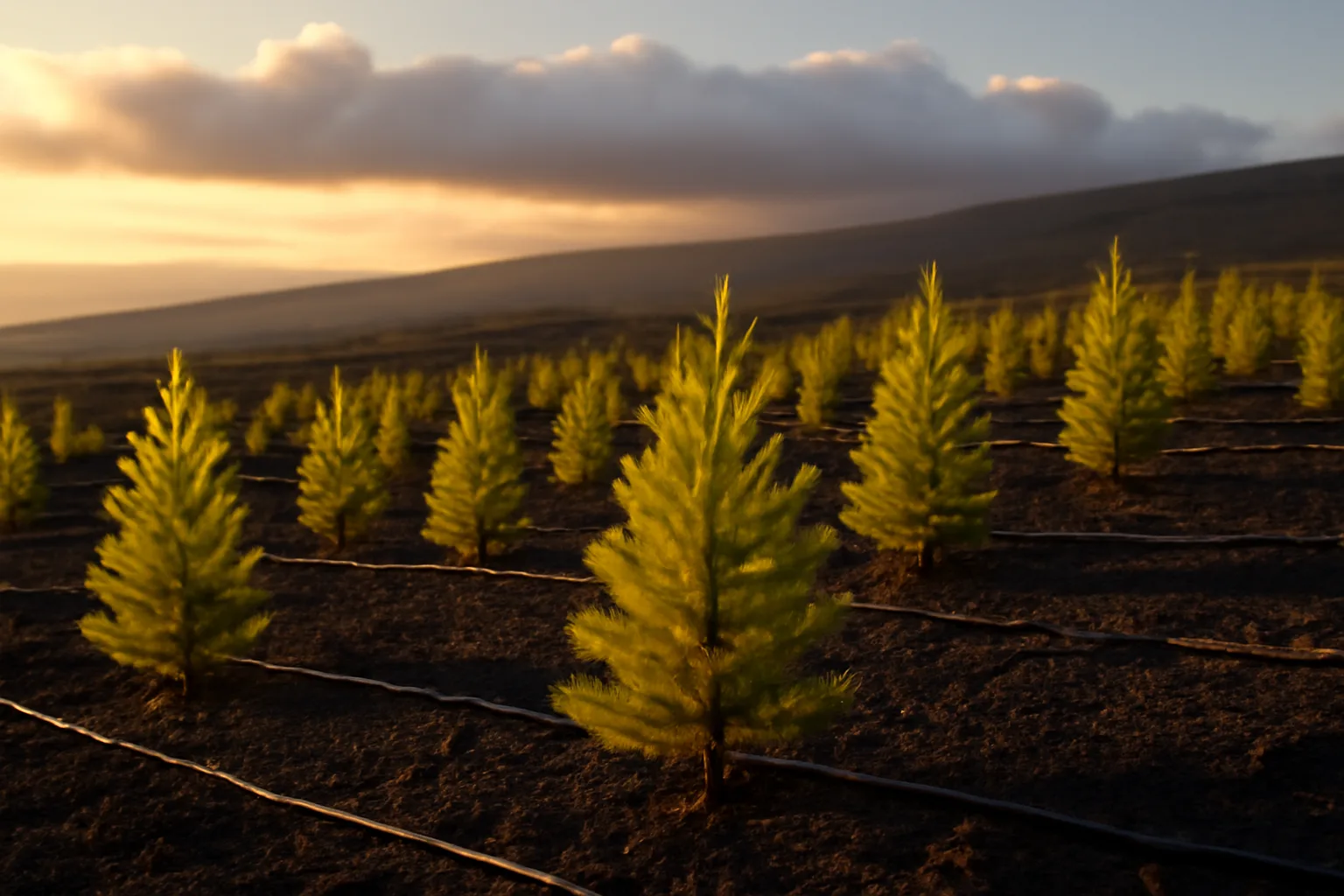
TL;DR
A Hawaii Christmas tree farm needs a DCCA entity, a GET license, county zoning that allows the crop, and HDOA clearance before plants arrive. Firs almost never work here. Grow Cook pine, Norfolk Island pine, or high-elevation Monterey pine. Budget 4 to 8 years to a first field cut, plus land and water that cost more than the trees. Confirm fees with each board.
How do you actually start a Christmas tree farm in Hawaii?
People treat this like one state permit. It is not. A christmas tree farm hawaii project is a land problem, a plant-quarantine problem, and a tax-registration problem. The trees are the easy part, and they are not easy.
Start with the parcel. Confirm it sits in the State Land Use Agricultural District or a county zone that already allows crop production. HRS §205-4.5 lists "Cultivation of crops, including crops for bioenergy, flowers, vegetables, foliage, fruits, forage, and timber" as a permitted agricultural-district use [3]. Christmas trees sit in that crop and timber bucket. Coastal lots can also trigger Special Management Area review. Ask the county planning counter before you sign anything.
Then register the business. DCCA Business Registration is where entities and trade names go [12]. After that, file for a general excise tax license with the Department of Taxation. Do that before you take a dollar [1]. If any plant, cutting, or soil comes from outside Hawaii, stop and read the HDOA Plant Quarantine rules. A mainland nursery cannot drop Fraser fir plugs in Hilo [4][5].
I would lease a few irrigated acres for a trial block before I bought land. Hawaii real estate is slow to unwind if the species fails. Water, pigs, and wind will decide more than your logo will.
Compare the paper load with a big producing state if you want context. The California start guide is the closest large Pacific example. Hawaii is hotter, smaller, and stricter at the dock.
Do you need a license for a Christmas tree farm in Hawaii?
Yes. You need at least a Hawaii general excise tax license before you sell trees, plus a DCCA business registration, and you often need HDOA clearance if you import plants or run a nursery-style yard. There is no single Christmas tree farm card issued by one board.
HRS §237-9 makes a GET license a condition of doing taxed business in the state [1]. Retail choose-and-cut and lot sales are retailing. Sales to lots and stores can be wholesaling if you meet the statute. The rates differ [2]. Confirm the current Form BB-1 process and any license fee with the Department of Taxation. Do not trust a blog for the dollar amount. Fees move.
DCCA handles the entity. Sole props still often file a trade name. LLCs and corporations file formation papers [12]. Counties can add a general business permit or a farmstand limit. Honolulu, Hawaii, Maui, and Kauai do not share one form.
If you apply restricted-use pesticides, you need HDOA applicator certification [13]. If you import nursery stock, Plant Quarantine has to clear it before arrival [5]. Workers' compensation, temporary disability insurance, and prepaid health care kick in once you have employees. Those are real obligations here, not optional extras.
Agency | What you file | When ---|---|--- DCCA | Entity or trade name | Before revenue Department of Taxation | GET license (Form BB-1) | Before revenue HDOA Plant Quarantine | Import notice or permit | Before plants arrive County planning | Zoning, SMA, farmstand | Before site work or retail DLIR | UI, TDI, prepaid health, workers' comp | Before first hire
Short version: no specialty tree license, several real ones. Confirm each filing with the board that issues it. Nobody can honestly promise you an approval date. For a mainland license contrast, see California license rules.
How much does a Christmas tree farm cost in Hawaii?
Nobody publishes a clean, current startup budget for a christmas tree farm hawaii project. The honest answer is a stack of line items, and land plus water will dwarf the seedlings.
Farm real estate here runs well above most mainland ag counties. USDA NASS land-value reports often have thin Hawaii samples, and some years they do not print a Hawaii average at all. Listed agricultural parcels range from rough pasture on Hawaii Island to irrigated land on Maui and Oahu that prices like development inventory. I would not underwrite a plan on a national per-acre figure. Get a local comparable. Ask the county about agricultural dedication for property tax.
Irrigation is not optional on leeward slopes. Tanks, pumps, filters, and drip add up. Fencing against feral pigs is a real line item, not a hobby. Those animals root new plantings overnight.
Seedlings cost more than mainland catalogs imply once you add inspection, possible rejection, and legal local production. A soil test from the UH CTAHR Agricultural Diagnostic Service Center is cheap next to a wrong fertilizer program. Confirm current panel prices with ADSC [15].
Labor is priced by statute. Hawaii's minimum wage is $16.00 an hour as of January 1, 2026 under HRS §387-2 [6][7]. The same statute schedules $18.00 on January 1, 2028. If you hire, add workers' comp, TDI, unemployment, and prepaid health care. That package is why I would keep year one owner-operated.
Insurance, a small tractor or walk-behind, pruning gear, and a gravel parking pad all cost real money. Mainland enterprise budgets, including the Alabama cost notes, are useful only as a checklist of categories. They understate Hawaii land, freight, and payroll.
If someone quotes a single turnkey number, walk away. Build a spreadsheet. Confirm tax and wage figures with the agencies. Leave a fat contingency for pig damage and a failed species block.
How long does a Christmas tree farm take in Hawaii?
A field-grown cut tree in Hawaii usually takes 4 to 8 years from transplant, depending on species, elevation, and how hard you shear. You will not harvest a plantation block in year one. Living potted Norfolk Island pines can sell sooner, often in 2 to 4 years if you start with decent liners.
That 4 to 8 year window is a practitioner range, not a statute. Traditional Fraser fir rotations on the mainland often run 7 to 12 years in cooler states. Hawaii does not give those firs the winter chill they want. USDA plant hardiness maps place Hawaii in zones 10 through 13 [8]. Fast tropical conifers fill the gap. They also get woody and lose Christmas shape if you wait too long.
Permitting time sits on top of biology. DCCA and GET filings are paperwork you finish before planting. HDOA import review happens before plants leave the mainland, and a rejected shipment burns a season. County grading or SMA permits, if they apply, can stretch months. Confirm current processing with the county. I will not invent a number.
Plan the business like a delayed crop. Cash in years 1 to 3 has to come from savings, another farm enterprise, potted sales, or off-farm work. Anyone promising a full choose-and-cut lot next December from bare ground is selling a story.
What Christmas tree species actually grow in Hawaii?
Grow what the climate already supports. Cook pine (Araucaria columnaris), Norfolk Island pine (Araucaria heterophylla), and, at cooler high-elevation sites, Monterey pine (Pinus radiata) are the species that actually make a tree-shaped product here [9].
The Forest Service handbook Common Forest Trees of Hawaii describes both araucarias as widely planted on the islands [9]. They take shearing. They also look like the living trees local families already put in apartments.
Species | Where it works | Product | Rough wait ---|---|---|--- Cook pine | Most islands, many elevations | Cut or landscape | 4 to 8 years Norfolk Island pine | Lower elevation, containers | Living Christmas tree | 2 to 4 years Monterey pine | Cooler mauka sites | Cut | 4 to 7 years Fraser fir | Low elevation | Usually a fail | Do not plant a field of it
Fraser fir, balsam, and Douglas-fir want a cold dormancy you do not have near the coast. I would not spend import money on them for a hot Maui or Honolulu County field. High slopes on Hawaii Island are cooler. Even there, test a small block. Wind and tropical disease will teach you faster than a catalog.
Italian stone pine and a few other pines show up in local talk. Treat those as trials. Keep records. Do not plant 10 acres of a hunch.
Shearing still matters. An unsheared Cook pine is a column, not a Christmas tree. Budget labor for that every year after the second or third. If you came from fir country, read a Colorado start path and then do the opposite on species.
What land, zoning, and water rules apply in Hawaii?
You need land in an agricultural use district, or a county zone that allows the crop, plus a legal water source you can actually turn on in a drought.
State Land Use Law puts most farmable land in the Agricultural District. HRS §205-4.5 is the permitted-use list. Crop cultivation and timber are on it [3]. County zoning sits on top. Hawaii County, Maui County, Kauai County, and the City and County of Honolulu each have their own ordinance and permit counter. Ag-tourism or a retail farmstand can trigger extra review even when the trees themselves are fine.
Water is the silent veto. Surface diversions sit under the Commission on Water Resource Management. County boards of water supply run meters and ag rates. Catchment is common on Hawaii Island and comes with water-quality work if you spray or host the public. Confirm allocation and meter fees with the board that owns the pipe. I would not close on a parcel until I saw the water documents.
Agricultural dedication programs can cut property tax if you keep the land in bona fide ag use. Rules and minimum acreage differ by county. Confirm with the real property tax office. Losing dedication after you open a gift shop is a classic own-goal.
SMA permits apply near shore. If your farm is a coastal lot you hope to rezone later, you are in a different business. Plant trees where farming is the long use.
What HDOA plant quarantine rules hit you first?
HDOA Plant Quarantine can stop a seedling shipment at the airport. That is the first operational rule most mainland growers miss.
HRS §150A-5 tells a person who brings in a restricted article to notify the department upon arrival, in writing, for freight, air freight, baggage, or other entry [4]. The Plant Quarantine import program is how that statute is run day to day [5]. Do it the way the branch instructs. Do not hide cuttings in a suitcase. That is how you get product destroyed and a bad file.
Soil on roots is a frequent problem. Bare-root stock or an approved growing medium, with phytosanitary certificates from the origin state, is the usual path. Confirm the current approved list with the Plant Quarantine Branch before you pay a mainland nursery. Rules change when a pest flares.
Interisland movement has its own checks. A Big Island planting is not automatically free to ship potted trees to Oahu without asking. Treat each island like a border.
If you only plant stock already growing in Hawaii, you skip a lot of this. That is why I would start with local liners even if they cost more per plant. A cheap mainland plug you cannot land is not cheap.
Read the import program page, then call the branch with your species list [5]. Get the answer in writing.
What taxes, payroll, and health-care rules apply when you sell?
Retail tree sales owe Hawaii general excise tax at the retailing rate. Wholesale sales can qualify for the much lower wholesaling rate if you meet the statute. HRS §237-13 sets the general excise tax at four per cent on retailing and one-half of one per cent on wholesaling [2]. Some counties add a surcharge. Confirm the surcharge for your island with Taxation. File on the periodic GET return they assign you.
Federal farm income still goes on Schedule F. IRS Publication 225 is the farmer's tax guide [14]. Tree preproductive years have federal capitalization rules. Talk to a CPA who has filed Hawaii farm returns. I am not your CPA.
Hire anyone and Hawaii gets expensive. Hawaii's minimum wage is $16.00 an hour as of January 1, 2026 under HRS §387-2 [6][7]. Workers' compensation applies. Temporary disability insurance applies. The Prepaid Health Care Act is the one that shocks mainland operators. HRS §393-11 says "Every employer shall provide coverage for the employer's employees under a prepaid health care plan" once those employees meet the eligibility tests [10][11]. Confirm current hour thresholds and exemptions with the Disability Compensation Division. Seasonal cutters can still trigger it.
That is why a tiny owner-run lot can pencil when a hired crew does not. I would not staff a first harvest like an Oregon U-cut until I had the benefit stack priced. For a contrast on a state with no GET, skim the Alaska license notes.
Should you run choose-and-cut, potted living trees, or wholesale?
I'd chase living potted trees near Honolulu demand, or a small choose-and-cut on land I already controlled at elevation. Straight wholesale cut trees against the November mainland boat is a tough way to live.
Imported cut trees show up every holiday season. HDOA inspects those shipments. Price competition is real. Your local story has to be freshness, a living tree, or an outing. A dusty roadside pile of Cook pine next to cheap shipped firs will sit.
Choose-and-cut needs parking, toilets, insurance, and a county look at public access. It also needs trees in the ground years earlier. Potted Norfolk pines can turn faster and ride in a pickup to a condo. Wholesale to garden shops is steadier if you can hit the wholesale GET lane correctly [2]. Misclassify retail as wholesale and Taxation will not be amused.
Mix if you must. Do not build bathrooms for a choose-and-cut you cannot fill for six years.
The Arizona start guide is another hot-climate path worth reading. Different species. Same honesty about heat. An Alaska start guide shows the other extreme, where cold is the crop's friend and Hawaii's enemy.
What does first-year work look like on a Hawaii planting?
Year one is paper, water, fence, soil, and a small test block. It is not a roadside lot with wreaths.
File DCCA and GET. Confirm zoning. Get the HDOA answer on stock. Soil-test through CTAHR ADSC and correct what the lab actually found [15]. Run irrigation and walk it at noon. Build pig-proof fence before you plant, not after the first night of rooting.
Plant a test species mix, not a monoculture. Shear nothing the first season on tiny liners. Keep a notebook of deaths. Windward rain and leeward drought kill in different months.
If you want a paper pack that lays out a shear year and a choose-and-cut checklist, ChooseAndCutPath sells a $149 one-time Shear-Year + Choose-and-Cut Kit. You do not need it to follow the agency steps in this article.
Stay owner-operated. Watch GET filing dates. Do not hire a crew you then owe prepaid health care for. Replant failures in the same season if water allows.
That is a good year. Boring. Alive.
What insurance and liability should you carry in Hawaii?
Carry farm liability that names choose-and-cut and roadside sales if you host the public. A homeowner policy will not do that job.
Uneven lava-rock paths, saws, and kids are a claims factory. Require closed shoes. Stage a first-aid kit. Map the ambulance route, which on some Hawaii Island roads is not fast.
Workers' compensation is mandatory once you have employees. Vehicle insurance needs to cover farm use and any shuttle. If you burn piles, check county fire rules before you light anything in dry season.
I would not open the gate to customers without a written policy in hand. Bind coverage before the first social post.
Product liability for a living tree is milder than for a cut tree that dries out in a living room. You still give care tags. You still tell people to water.
Confirm limits with a Hawaii-licensed agent who has written farms, not a mainland packager. The Alabama start path is a useful reminder that every state splits liability, tax, and ag paper differently. Copy no one blindly.
What paper should you file in what order?
File in this order so you do not plant a crop you cannot sell.
First, confirm zoning and water in writing with the county and the water board. Second, form the entity or trade name at DCCA [12]. Third, apply for the GET license with Taxation [1]. Fourth, take any plant-import plan to HDOA Plant Quarantine before you order stock [5]. Fifth, if you will spray restricted-use products, start applicator certification [13]. Sixth, if you will hire, open the DLIR accounts for unemployment, TDI, prepaid health care, and workers' comp [10][11]. Seventh, set a federal EIN and read Publication 225 [14].
Then plant.
Renewals sit on agency calendars, not on your harvest calendar. GET returns keep coming in years you sell nothing if you still have incidental income. Confirm filing frequency with Taxation.
More checklists live at /start. ChooseAndCutPath is an independent publisher, not a law firm and not a service company. Confirm every fee and form with the board that issues it. No one here can promise you an approval or a date.
Frequently asked questions
Do you need a license for christmas tree farm in hawaii?
Yes. You need a DCCA business registration and a Hawaii GET license before you sell, plus county sign-off on the land use. HDOA Plant Quarantine clearance is required if plants or soil enter the state. There is no single Christmas-tree card. Confirm current forms and fees with Taxation, DCCA, HDOA, and your county. No approval timeline is honest to promise.
How much does christmas tree farm cost in hawaii?
There is no published Hawaii turnkey figure. Land, irrigation, pig fencing, and payroll dominate. Seedlings are the small line. Minimum wage is $16.00 an hour as of January 1, 2026 under HRS §387-2, and hired crews also trigger workers' comp, TDI, and prepaid health care. Build a local spreadsheet. Confirm tax and wage numbers with the agencies.
How long does christmas tree farm take in hawaii?
A field-grown cut tree usually takes 4 to 8 years from transplant, depending on species, elevation, and shearing. Potted Norfolk Island pines can sell in about 2 to 4 years. Year one is paper, water, fence, and a test block, not a full choose-and-cut lot. Import rejections and county permits can add a season. Confirm processing with the county and HDOA.
Can you grow Fraser fir on a Christmas tree farm in Hawaii?
Almost never at low elevation. USDA hardiness maps put Hawaii in zones 10 through 13, and Fraser fir wants a real winter. High mauka sites on Hawaii Island are cooler, but a full field of imported fir is still a gamble I would not fund. Trial a few trees if you already have the land. Put real acres into Cook pine or Norfolk Island pine.
Is there a single Christmas tree farm board in Hawaii?
No. DCCA registers the business. Taxation issues the GET license. HDOA handles plants and pesticides. Each county handles zoning, SMA, and farmstands. DLIR handles hired labor. You talk to all of them. Anyone selling a one-stop Hawaii tree-farm permit is not describing the actual paper path.
Do you pay GET on choose-and-cut sales in Hawaii?
Yes. Choose-and-cut and lot sales are retailing. HRS §237-13 sets retailing at four per cent. Qualifying wholesale sales to other dealers can sit at one-half of one per cent. Some counties add a surcharge. Confirm your island's surcharge and filing frequency with the Department of Taxation. Mislabeling retail as wholesale is a bad audit.
Can you import Christmas tree seedlings from Oregon into Hawaii?
Only if HDOA Plant Quarantine clears the shipment. HRS §150A-5 requires written notice when restricted articles arrive. Soil on roots is a common reject. Use the current approved media list and origin phytosanitary papers. Confirm the species and growing medium with the branch before you pay the nursery. Local liners skip a lot of this risk.
Does Hawaii require health insurance for Christmas tree farm employees?
Often yes, once workers meet Prepaid Health Care Act tests. HRS §393-11 requires employers to provide coverage under a prepaid health care plan for eligible employees. Hour and waiting-period details belong to the Disability Compensation Division, not a blog. Confirm before you hire seasonal cutters. This is why many first-year lots stay owner-run.
Can you run choose-and-cut on agricultural land in Hawaii?
Growing the crop fits agricultural-district use under HRS §205-4.5. Hosting the public, parking, and a farmstand can still need county review. SMA rules apply near shore. Ask planning before you advertise. Bind liability insurance that names public picking. Do not assume a crop permit is also a retail-tourism permit.
Which Hawaiian island is best for a Christmas tree farm?
Hawaii Island has more mauka acreage and cooler nights in places like the Kamuela and Volcano belts, which helps pine shape. Oahu has the customers. Maui and Kauai sit in between, with tighter land and water. I would plant where I already controlled irrigated land. I would not buy a hot coastal lot just to chase a holiday brand.
Do you need a pesticide license to spray Christmas trees in Hawaii?
You need HDOA applicator certification if you use restricted-use pesticides. General-use products still have label law behind them. Many small plantings can stay on cultural controls and legal general-use materials. Confirm the product's Hawaii status with the Pesticides Branch before you spray. Certification is a class and exam path, not a same-week card.
Can you sell living potted Norfolk Island pines as Christmas trees?
Yes, and that is the product I would actually start with near town. They already grow in Hawaii landscapes, they fit condos, and they can sell years sooner than a sheared field tree. You still need GET, DCCA, and any county retail rules. Interisland movement of potted plants can trigger HDOA checks. Ask before you barge trees to Oahu.
Are feral pigs a real risk on a Hawaii Christmas tree planting?
Yes. Pigs root liners and knock drip lines. Fence before you plant. A cute test row with no hog wire is how you buy the same trees twice. This is a Hawaii field fact, not a mainland deer problem with a different name. Budget materials and gates like they matter, because they do.
Do you need workers' compensation for seasonal tree cutters in Hawaii?
Once you have employees, Hawaii workers' compensation applies. TDI and prepaid health care can apply too. Owner-only operations sit in a different spot than a hired Saturday crew. Confirm coverage with your carrier and the Disability Compensation Division before the first paid hour. Do not guess from a mainland farm policy.
Sources
- Hawaii Revised Statutes §237-9 Licenses; penalty: A GET license is required as a condition of engaging in business taxed under Hawaii's general excise tax chapter.
- Hawaii Revised Statutes §237-13 Imposition of tax: GET is imposed at four per cent on retailing and one-half of one per cent on wholesaling.
- Hawaii Revised Statutes §205-4.5 Permissible uses within the agricultural districts: Cultivation of crops, including flowers, foliage, forage, and timber, is a permitted use in the agricultural district.
- Hawaii Revised Statutes §150A-5 Notice of arrival: A person who brings a restricted article into Hawaii must notify the Department of Agriculture upon arrival.
- Hawaii Department of Agriculture Plant Quarantine Import Program: HDOA Plant Quarantine regulates importation of plants and plant parts into Hawaii and requires inspection and compliance before entry.
- Hawaii Revised Statutes §387-2 Minimum wages: Hawaii minimum wage is $16.00 per hour beginning January 1, 2026 and $18.00 beginning January 1, 2028.
- Hawaii Department of Labor and Industrial Relations Wage Standards Division minimum wage page: DLIR publishes the statutory Hawaii minimum wage schedule that employers must follow.
- USDA Agricultural Research Service Plant Hardiness Zone Map: Hawaii falls in USDA plant hardiness zones 10 through 13.
- USDA Forest Service PSW-GTR-26 Common Forest Trees of Hawaii (Native and Introduced): Cook pine and Norfolk Island pine are widely planted introduced trees in Hawaii and are described in the standard Forest Service handbook.
- Hawaii Revised Statutes §393-11 Prepaid Health Care Act coverage by employer: Every employer shall provide coverage for the employer's employees under a prepaid health care plan when eligibility tests are met.
- Hawaii DLIR Disability Compensation Division Prepaid Health Care Act overview: Hawaii's Prepaid Health Care Act requires covered employers to provide health care coverage to eligible employees.
- Hawaii DCCA Business Registration Division, Register a Business: Business entities and trade names are filed with the Department of Commerce and Consumer Affairs Business Registration Division.
- Hawaii Department of Agriculture Pesticide Applicator Certification and Recertification: HDOA certifies pesticide applicators who use restricted-use pesticides.
- IRS Publication 225, Farmer's Tax Guide: Federal farm income, expenses, and capitalization rules for farmers are explained in Publication 225.
- University of Hawaii CTAHR Agricultural Diagnostic Service Center: CTAHR ADSC provides soil and tissue testing for Hawaii growers; current panel prices are set by the lab.